
API Security Testing Buyer's Guide: An RFP-Style Evaluation Framework (2026)
An RFP-style framework for evaluating API security testing tools at enterprise scale. Twelve evaluation dimensions, weighted scoring, vendor questions, and the trade-offs that matter for regulated buyers.
What is this
An API security testing buyer's guide is a structured framework — not a ranked vendor list — for evaluating commercial API security testing tools at enterprise scale. The 2026 version covers twelve dimensions across capability, deployment posture, AI inference path, and total cost of ownership, with explicit weighting per buyer profile (regulated vs non-regulated). The framework matters more than the vendor; buyers who skip the framework consistently end up replacing the tool within 18 months.
Key components
Each enterprise program in this area has the same load-bearing components, regardless of vendor. The components separate cleanly into governance, enforcement, and evidence layers.
OWASP API Top 10 coverage depth
The minimum bar for credible API security testing in 2026. Depth varies hugely between vendors — checklist coverage versus genuine threat-model-driven test generation. Score against your test corpus, not vendor demo content.
Deployment posture
SaaS only / private cloud / on-prem / air-gapped. Often the disqualifier for regulated buyers. A SaaS-only tool is almost always disqualified by procurement at regulated organizations regardless of capability score.
AI inference path
Cloud-LLM-only / self-hosted-capable / fully air-gapped. The most common AI-policy review issue in 2026. A tool that can only generate tests via a cloud LLM API will fail AI policy review at most regulated buyers.
Multi-protocol coverage
REST + SOAP + GraphQL all first-class, or only some. Realistic enterprise integration surfaces still include SOAP for core banking, insurance, healthcare, and government. Legacy compatibility modes don't produce reliable contract validation.
CI/CD integration depth
First-party plugins for the systems your team operates, or generic CLI hacks. The difference at enterprise scale is whether the integration carries quality gates, evidence emission, and signed-token authentication.
Evidence retention and export
Run reports queryable, exportable, retainable in standard formats. Audit-readiness for SOC 2 Type II, FedRAMP CA-7, HIPAA evaluation, PCI-DSS Requirement 11. Tools that auto-expire CI artifacts fail enterprise audit cycles.
Table of Contents
- The twelve evaluation dimensions
- Weighted scoring framework
- Disqualifier dimensions
- Vendor questions worth asking
- Common evaluation pitfalls
The twelve evaluation dimensions
A complete API security testing evaluation in 2026 covers twelve dimensions. Not every dimension is critical for every buyer, but every dimension should be deliberately scored — including the ones you decide to weight at zero.
| # | Dimension | Why it matters |
|---|---|---|
| 1 | OWASP API Top 10 coverage depth | The minimum bar for credible security testing |
| 2 | Authentication & authorization testing | Most production breaches start here |
| 3 | AI test generation quality | Productivity multiplier; depth varies hugely between vendors |
| 4 | Multi-protocol coverage (REST/SOAP/GraphQL) | Realistic enterprise integration surface |
| 5 | CI/CD integration depth | Tests that don't run in CI don't test anything |
| 6 | Deployment posture (SaaS / on-prem / air-gapped) | Often the disqualifier for regulated buyers |
| 7 | AI inference path (cloud / self-hosted) | Most common AI-policy review issue |
| 8 | Data residency control | GDPR / Schrems II / sovereign-cloud fit |
| 9 | RBAC and audit logging | Required for any in-scope authorization |
| 10 | Evidence retention and export | Audit-readiness; Type II SOC 2; FedRAMP CA-7 |
| 11 | Vendor support model | Time-to-resolution on production-impacting issues |
| 12 | Total cost of ownership | License + ops + integration + procurement |
A buyer's guide isn't a ranking. It's a framework that produces your ranking based on your weights.
Weighted scoring framework
A practical weighting pattern for regulated enterprise buyers in 2026:
| Dimension | Weight (regulated) | Weight (non-regulated) |
|---|---|---|
| Deployment posture | 15% | 5% |
| AI inference path | 12% | 4% |
| OWASP API Top 10 coverage | 10% | 12% |
| Authentication / authorization testing | 10% | 10% |
| CI/CD integration | 9% | 14% |
| AI test generation quality | 8% | 12% |
| Multi-protocol coverage | 8% | 6% |
| RBAC + audit logging | 7% | 8% |
| Data residency control | 7% | 4% |
| Evidence retention / export | 6% | 8% |
| Vendor support | 4% | 8% |
| TCO | 4% | 9% |
Weights vary substantially by industry. A bank weights deployment posture differently than a B2B SaaS startup. The point is to make the weights explicit and reviewed by stakeholders before scoring vendors — not to argue about scoring after the fact.
Disqualifier dimensions
Three dimensions can disqualify a vendor regardless of how strong they score elsewhere:
Deployment posture for regulated buyers. A SaaS-only tool with no on-prem or self-hosted option is almost always disqualified by procurement at regulated organizations — look for a tool that can run tests entirely behind your firewall. Don't waste deep evaluation cycles on tools that fail this gate.
Ready to shift left with your API testing?
Try our no-code API test automation platform free. Generate tests from OpenAPI, run in CI/CD, and scale quality.
AI inference path for AI-policy-reviewed buyers. A tool that can only generate tests via a cloud LLM API will fail AI policy review. The fallback question is whether the tool supports self-hosted LLM as a first-class option or as a workaround.
Audit evidence for regulated buyers. A tool that doesn't produce queryable, exportable, retainable run reports cannot demonstrate the controls required for SOC 2 Type II, FedRAMP CA-7, HIPAA evaluation, or PCI-DSS Requirement 11.
If a vendor fails any of the three for your specific posture, score them out before deep evaluation. It saves weeks.
Vendor questions worth asking
Five questions that separate marketing from operational reality:
"Can we run this without any outbound network connections from your platform?" Answers vary from "yes, fully air-gapped" to "the platform itself is on-prem but it phones home for license and updates." Map the answer against your air-gap requirement.
"What happens if your hosted LLM endpoint is unreachable?" The right answer is "we fail closed and surface an error." Wrong answers include "we fall back to OpenAI" or "we cache and retry with telemetry." This is the AI-policy review answer.
"Show me the network connections during a test run." Vendors that can produce this clearly are usually clean. Vendors that struggle have undocumented data flows.
"What's your roadmap for SOC 2 / FedRAMP / your compliance need?" Get a year-honest answer. Soft commitments slip; written ones less often.
"Who is on the support escalation path and where are they located?" Material for data-residency requirements (Schrems II), SLA evaluation, and time-zone fit.
Common evaluation pitfalls
Three patterns that lead to bad enterprise buys:
Listicle anchoring. Starting evaluation from a third-party "best tools" list usually skips the disqualifiers. The list-author's weights aren't yours.
Demo-driven decisions. Vendor demos optimize for visual impact. Six months of operation, integration with your CI, and sustainable test maintenance look very different.
Underweighting the AI inference path. In 2024 this was a footnote. In 2026 it's often the #1 procurement-blocking dimension. Score it explicitly.
For complementary content see the API security testing tools comparison and on-prem API testing platforms buyer checklist.
A useful API security testing buyer's guide isn't a ranked list. It's a framework that surfaces the dimensions, makes the weights explicit, and pre-filters by disqualifiers before consuming deep evaluation cycles. The twelve-dimension model holds up across most regulated enterprise contexts — adjust the weights, but score every dimension deliberately.
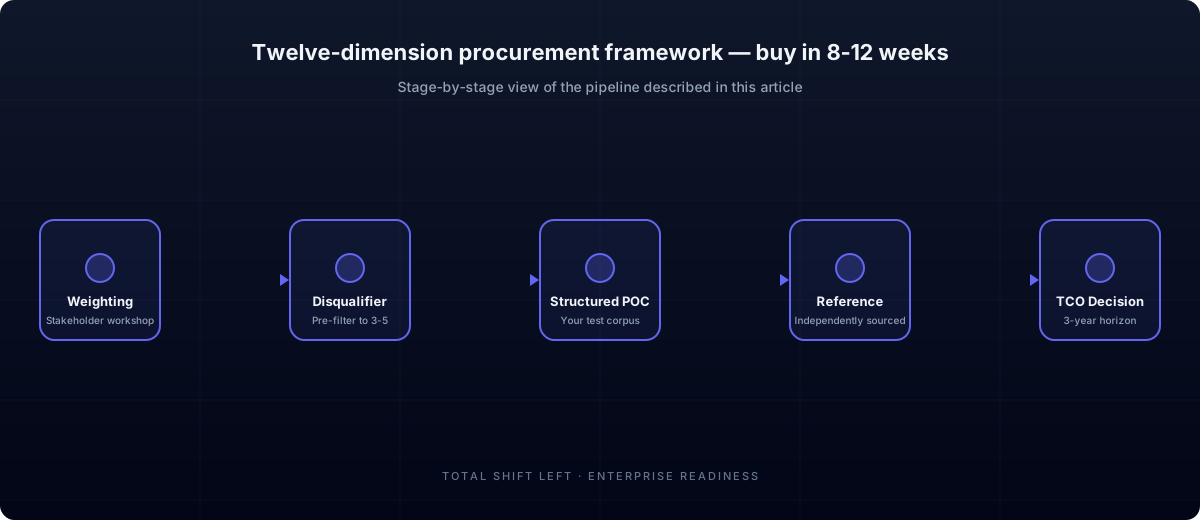
API security testing buyer's framework — twelve-dimension weighted scoring.
Why this matters at enterprise scale
Gartner's 2025 procurement timeline benchmark found that regulated buyers with explicit weighted-scoring frameworks closed API security testing buys 43% faster than buyers using informal evaluation, and reported significantly fewer post-buy regrets at the 12-month mark. The framework matters more than the vendor — buyers who skip the framework consistently end up replacing the tool within 18 months.
Tools landscape
A practical view of the tool categories that scale across enterprise testing programs in this area:
| Category | Example tools |
|---|---|
| Evaluation framework | Internal RFP templates, weighted scoring spreadsheets |
| POC environments | Sandbox tenants for each shortlisted vendor; standardized test corpus |
| Reference checks | Peer networks (CISO forums, ISC2, ISACA), Gartner Peer Insights, G2 |
| Procurement support | Internal procurement, legal review, security questionnaire workflows |
| TCO modeling | License + ops + integration + procurement time; 3-year horizon |
Tool selection is secondary to architecture. The patterns above hold regardless of which specific vendor you adopt.
Real implementation example
A representative deployment pattern from an enterprise rollout in this area:
Problem. A healthcare CISO evaluated five API security testing vendors over 6 months without a structured framework. The team rotated weight on different dimensions across rounds. Final selection was driven more by vendor sales effort than fit. The chosen tool was replaced within 14 months.
Solution. The next buy used a weighted 12-dimension framework reviewed by stakeholders before vendor outreach. Disqualifier dimensions (deployment posture, AI inference path, audit evidence) pre-filtered to three vendors. POC scoring was structured. Procurement closed in 8 weeks.
Results. The selected vendor remained in production 30+ months later. Operational satisfaction (measured quarterly) stayed above 4/5. The framework is now reused across other security tooling buys at the organization.
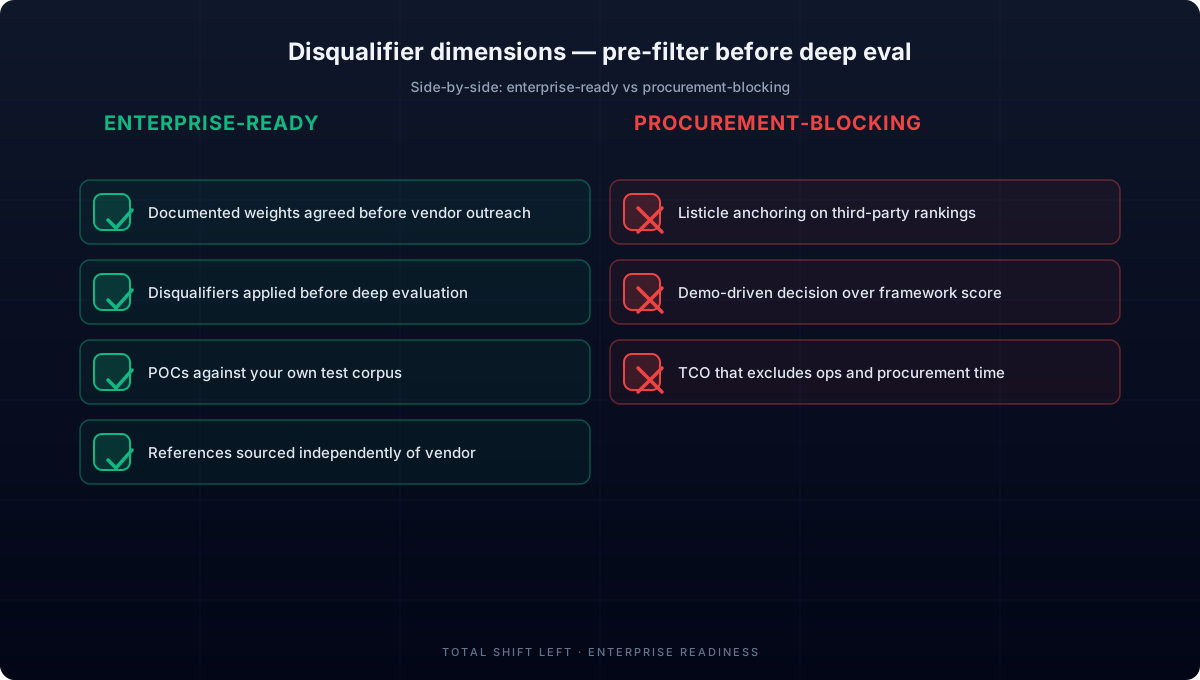
Enterprise buyer's guide — disqualifier checklist.
Reference architecture
A structured procurement process has six components. Stakeholder weighting workshop — runs once per buy, before vendor outreach. Engineering, security, compliance, procurement, and platform teams set weights against the twelve dimensions and document rationale. Disqualifier filtering — vendors failing any of the three disqualifiers (deployment posture, AI inference path, audit evidence) are eliminated before deep evaluation. Structured POC — shortlisted vendors run against a standardized test corpus the buyer provides. Scoring is structured against the framework, not impression. Independent reference checks — sourced from CISO peer networks, Gartner Peer Insights, G2, not vendor introductions. References are asked specifically about failure modes. TCO modeling — 3-year horizon including license, ops, integration, and procurement (especially repeat procurement on tool replacement). Decision documentation — final buy decision is documented with rationale for the next replacement cycle. The architecture is process discipline rather than technology.
Metrics that matter
Three metrics validate the procurement process. Time-to-buy — calendar weeks from stakeholder workshop to closed contract — should compress with framework discipline; mature procurement teams close in 8-12 weeks versus 6-9 months ad-hoc. Post-buy satisfaction — measured 6 and 12 months post-buy — separates buys that hold from buys headed for replacement. Tool replacement cycle — average lifetime of a security testing tool buy — is the lagging indicator; framework-driven buys typically extend lifetime 50%+ versus ad-hoc buys. Report to procurement and CISO leadership.
Rollout playbook
A structured buy executes in 8-12 weeks. Week 1: weighting workshop. Stakeholders agree on dimension weights. Weeks 2-3: long-list and disqualifier filtering. Identify candidates; eliminate vendors failing disqualifiers. Weeks 4-6: POC. Run shortlisted vendors against a standardized test corpus. Score against the framework. Weeks 7-8: reference checks and TCO modeling. Source independent references. Build 3-year TCO models. Weeks 9-12: contracting. Close commercial terms. Document the buy decision rationale. Mature procurement teams complete the cycle in 8-10 weeks; first-time framework users typically take 12-14.
Common challenges and how to address them
Stakeholders disagree on weights. Run a weighting workshop before vendor outreach. Document decisions. Don't re-litigate weights during scoring.
Vendor demos optimize for visual impact. Score against the framework, not the demo. Run structured POCs against your test corpus, not against vendor sample data.
Reference checks are sales-curated. Source independently — CISO peer networks, Gartner Peer Insights, G2. Ask references about the failure modes specifically.
TCO calculations exclude procurement and ops time. Model 3-year TCO including procurement (especially repeat procurement on tool replacement), ops, and integration. License is rarely the largest line.
Best practices
- Define weights before vendor outreach; document the rationale
- Use disqualifier dimensions to pre-filter — save deep evaluation cycles
- Run structured POCs against your own test corpus
- Source reference checks independently of vendor introductions
- Model 3-year TCO including procurement, ops, and integration costs
- Score against the framework, not against the demo
- Document the buy decision rationale for the next replacement cycle
Implementation checklist
A pre-flight checklist enterprise teams can run against their current state:
- ✔ Twelve-dimension framework is documented with weights
- ✔ Disqualifier dimensions are explicit and applied before deep evaluation
- ✔ POC environments are standardized; test corpus is shared
- ✔ Reference checks are sourced independently
- ✔ TCO model covers a 3-year horizon with all cost categories
- ✔ Vendor evaluation includes the security questionnaire response
- ✔ Stakeholder weighting workshop happens before vendor outreach
- ✔ Final decision is documented with rationale for next buy cycle
Take the next step. See how security testing for regulated industries applies these ideas to your workflow, or explore enterprise security for the broader picture.
See also: jwt authentication in our learn hub for the underlying concept.
Conclusion
A useful API security testing buyer's guide isn't a ranked list. It's a framework that surfaces the dimensions, makes the weights explicit, and pre-filters by disqualifiers before consuming deep evaluation cycles. The twelve-dimension model holds up across most regulated enterprise contexts — adjust the weights, but score every dimension deliberately. The framework, not the vendor, is what determines whether the buy holds up at the 18-month mark.
FAQ
How is this different from a "best tools" listicle?
A buyer's guide gives you the framework for choosing; a listicle gives you a ranked list of someone else's choices. Enterprise buys with regulated, on-prem, and compliance constraints rarely match the listicle order. This guide gives you the dimensions and the weights so your evaluation produces a defensible result.
What's the single highest-weight dimension in 2026?
For regulated buyers, deployment posture (self-hosted, AI inference path, data residency). It's the dimension most likely to disqualify an otherwise capable tool during procurement review. For non-regulated buyers, CI/CD integration and the depth of OWASP API Top 10 coverage usually weigh highest.
Should I buy or build?
Almost always buy at this point. The OWASP API Top 10 coverage depth, AI test generation, and CI/CD integration depth in commercial tools have outpaced what most internal teams can sustain. The remaining build cases are narrow: extreme sovereignty constraints, or unusual integration needs.
How many tools should we evaluate?
Three to five for most buys. Two is too few to surface trade-offs; more than five is mostly diminishing returns. Use the disqualifier dimensions (deployment posture, compliance fit) to pre-filter before deep evaluation.
Ready to shift left with your API testing?
Try our no-code API test automation platform free.