
API Testing for FedRAMP & StateRAMP Authorizations: NIST 800-53 Control Mapping (2026)
How API testing programs evidence NIST SP 800-53 Rev. 5 controls for FedRAMP Moderate / High and StateRAMP authorizations. Boundary discipline, AI policy alignment, and change-management evidence designed for the SSP.
What is this
API testing for FedRAMP and StateRAMP authorizations is the practice of producing documented evidence that NIST SP 800-53 Rev. 5 controls — particularly in the SA (System and Services Acquisition), CM (Configuration Management), AU (Audit and Accountability), and AC (Access Control) families — are operating effectively for any APIs handling federal information. It applies to FedRAMP Moderate / High authorizations and StateRAMP equivalents, with explicit boundary discipline being the most common failure mode.
Key components
Each enterprise program in this area has the same load-bearing components, regardless of vendor. The components separate cleanly into governance, enforcement, and evidence layers.
In-boundary test platform
The platform runs on the same authorized infrastructure as the system under test, deployed via container images pulled from the internal registry serving the boundary. The platform inherits the boundary's ATO; SaaS testing tools without their own FedRAMP authorization are excluded.
In-boundary AI inference
Self-hosted LLM (Ollama, vLLM, LM Studio) running on authorized infrastructure. Cloud LLM APIs (OpenAI, Anthropic, Google) almost never carry FedRAMP-equivalent authorization, so AI-assisted testing in FedRAMP-Moderate and above effectively requires self-hosted inference.
Self-hosted CI runners
CI runs on internal runners on authorized infrastructure — never on GitHub-hosted runners or other external CI services. The CI architecture is described in the SSP under SA-11 and CM-3.
CA-7 continuous monitoring
Recurring API security and contract test execution feeds the continuous-monitoring program. Run reports retained in GovCloud-eligible object storage with object-lock retention aligned to the authorization period (typically 3 years plus the CA-7 window).
AU-2 / AU-12 audit events
The test platform emits audit events into the system's log aggregation. Records cover who ran which test against which environment, satisfying AU-2 (audit events) and AU-12 (audit generation) for the test environment at production-equivalent fidelity.
SSP narrative integration
API testing is described in the SSP under SA-11 (developer testing and evaluation), CM-3 / CM-4 (change control), CA-7 (continuous monitoring), and AU-2 / AU-12 (audit events). The narrative covers cadence, artifacts, and retention; the artifacts live in the system inventory.
Table of Contents
- Where API testing fits in a FedRAMP / StateRAMP authorization
- The boundary discipline that auditors expect
- NIST 800-53 Rev. 5 control mapping
- SSP narrative patterns
- AI-assisted testing inside authorization boundaries
- Reference architecture
Where API testing fits
FedRAMP and StateRAMP authorize information systems against the NIST SP 800-53 Rev. 5 catalog at a defined impact level (Low, Moderate, High; or for StateRAMP also Category 1/2/3). API testing isn't its own control family, but several control families effectively require it:
- SA-11 — Developer testing and evaluation: requires the developer to perform documented testing including security testing.
- CM-3 / CM-4 — Configuration change control / security impact analysis: requires documented validation of changes before implementation.
- CA-7 — Continuous monitoring: requires ongoing assessment of control effectiveness.
- AU-2 / AU-12 — Audit events / audit generation: requires logging of security-relevant events including privileged actions on the test environment.
- AC-3 / AC-6 — Access enforcement / least privilege: tested through negative authorization tests.
The SSP narrative is where you tie the testing program to these controls. A Moderate authorization typically expects evidence of automated API testing on every change, retained run reports for the continuous monitoring program, and audit logs of test execution.
Boundary discipline
The most common authorization gap in API testing programs is boundary leakage: a test path that touches federal information but runs through infrastructure outside the authorization boundary. Three common patterns where this happens:
- Cloud-LLM AI test generation that sends OpenAPI specs or captured payloads to a model API outside the boundary.
- SaaS test platforms that store run reports, captured payloads, or test data in vendor-managed cloud storage outside the boundary.
- External CI runners (GitHub-hosted runners, etc.) that execute test suites with access to authorized environments.
For FedRAMP Moderate and above, all three need to be eliminated or explicitly authorized. The path of least resistance is a fully self-hosted test platform — including its LLM — running on the same infrastructure that holds the system's ATO. See the public-sector industry page for deployment patterns and the deployment page for topology options.
NIST 800-53 Rev. 5 control mapping
| Control | What API testing provides as evidence |
|---|---|
| SA-11(1) — static code analysis | Schema validation tests as static analysis on the API contract |
| SA-11(2) — threat modeling and vulnerability analysis | Documented OWASP API Top 10 test coverage (see mapping) |
| SA-11(8) — dynamic code analysis | Runtime API security tests in CI/CD |
| CM-3(1) — automated documentation, notification, and prohibition of changes | Automated CI test runs with quality gates blocking unapproved deltas |
| CM-4 — security impact analysis | Per-change test reports retained for the authorization boundary |
| CA-7 — continuous monitoring | Recurring API security and contract test execution with retained metrics |
| AC-3 / AC-6 — access enforcement / least privilege | Negative authorization tests on every protected endpoint |
| AU-2 / AU-12 — audit events / audit generation | Audit log of who ran which test against which environment |
| IA-2 / IA-5 — identification and authentication / authenticator management | Authentication negative tests across enterprise IdP flows |
Ready to shift left with your API testing?
Try our no-code API test automation platform free. Generate tests from OpenAPI, run in CI/CD, and scale quality.
The SSP doesn't require a one-test-per-control mapping. It requires a credible, sampleable program described in the narrative — which is far easier to produce when the platform can trace each NIST control back to the tests that evidence it rather than reconstructing the mapping by hand.
SSP narrative patterns
Three patterns scale well across FedRAMP/StateRAMP packages:
The integrated SDLC narrative. API testing is described as a step in the authorized SDLC. The narrative covers the cadence (every PR, every release, scheduled continuous monitoring runs), the artifacts produced (test definitions in source control, run reports retained), and the controls covered. SA-11 implementation references this narrative.
The continuous monitoring narrative. API testing appears as a continuous monitoring activity under CA-7. The narrative describes the schedule, what's tested, and how findings escalate. This is the pattern most reviewers find easiest to evaluate.
The change management narrative. API testing appears under CM-3 / CM-4 as the validation step that gates change approval. The narrative covers how test results inform the change-control board's decision and how evidence is retained for the authorization boundary.
Most mature SSPs reference API testing in all three places — the testing activity isn't different, but its role in each control area gets named explicitly so reviewers can find it.
AI-assisted testing inside boundaries
The single biggest authorization issue with modern API testing tools in 2026 is the AI inference path. Standard cloud LLM APIs almost never carry an equivalent FedRAMP authorization, which means an AI-assisted testing tool that calls them is reaching outside the boundary on every test generation.
Two architectures work inside the boundary:
- Self-hosted open-source models (Llama 3, Qwen, Mistral) running on Ollama, vLLM, or LM Studio on authorized infrastructure.
- In-boundary inference services offered by your cloud provider at the equivalent impact level (e.g. Bedrock in GovCloud, Vertex AI in Assured Workloads where authorization permits).
The test platform must be configurable to point at your in-boundary endpoint without external fallback. A platform that "supports self-hosted LLM" but quietly uses cloud LLM as a fallback creates an authorization gap.
Reference architecture
A reference architecture for FedRAMP-aligned API testing:
- Self-hosted test platform running on authorized infrastructure (or in-boundary cloud environment at the equivalent impact level).
- Self-hosted LLM for AI-assisted test generation; no external LLM API calls.
- Source-controlled test definitions in an in-boundary git repository.
- CI/CD integration running on in-boundary runners; no external CI execution.
- Run report retention in in-boundary storage with appropriate retention policy for the authorization period.
- Audit logging of all test execution, exported into the system's existing log aggregation.
For higher impact levels (FedRAMP High, IL5/IL6), add air-gapped deployment patterns — see air-gapped API testing for classified environments.
FedRAMP and StateRAMP do not require API testing as a named control, but the SA-11, CM-3/CM-4, CA-7, and AC-3 controls effectively make a documented testing program required for any authorized API surface. The architecture work in 2026 is on AI-assisted testing: keeping the inference path inside the authorization boundary is the difference between a clean SAR and a finding.
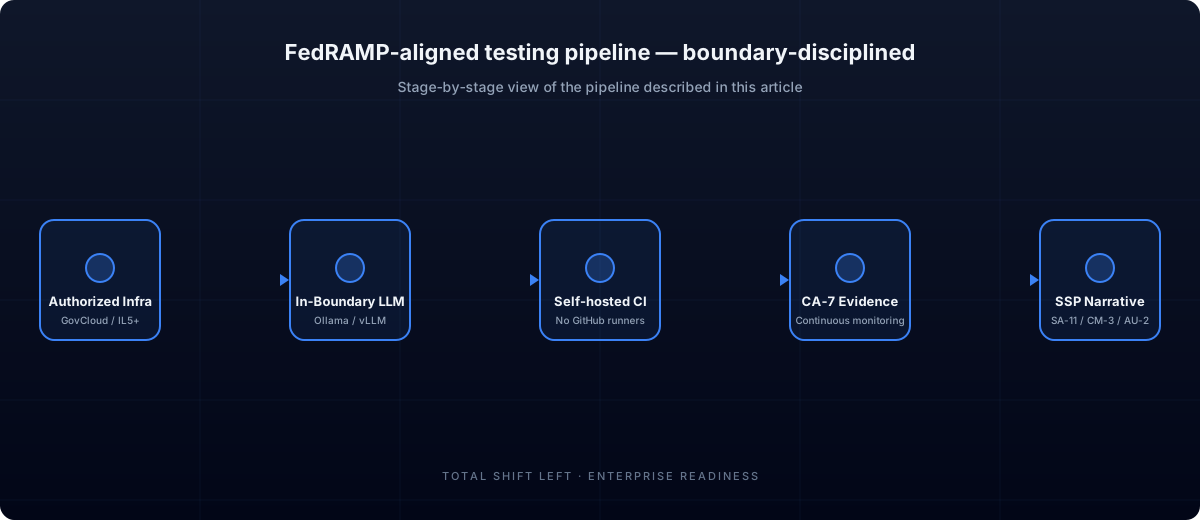
FedRAMP-aligned API testing — boundary-disciplined pipeline.
Why this matters at enterprise scale
FedRAMP Moderate authorizations increasingly require explicit documentation of AI-tool data flows in the SSP, and ATO timelines stretch to 12-18 months at agencies with active AI governance review. Authorizing officials are now disqualifying API testing tools whose inference paths cross the boundary — a delay measured in quarters, not weeks. Self-hosted, in-boundary tooling reduces both the SSP narrative complexity and the ATO timeline meaningfully.
Tools landscape
A practical view of the tool categories that scale across enterprise testing programs in this area:
| Category | Example tools |
|---|---|
| In-boundary inference | Ollama, vLLM, LM Studio with Llama 3 / Qwen / Mistral models |
| GovCloud-eligible storage | AWS GovCloud S3, Azure Government Blob, GCP Assured Workloads |
| CI/CD inside the boundary | Jenkins on GovCloud, self-hosted GitLab Runners, internal Azure DevOps |
| Continuous monitoring (CA-7) | Total Shift Left scheduled runs, CloudWatch / Azure Monitor with retention |
| Audit log aggregation (AU-2) | Splunk Enterprise, Elastic Stack with FedRAMP-eligible deployment |
Tool selection is secondary to architecture. The patterns above hold regardless of which specific vendor you adopt.
Real implementation example
A representative deployment pattern from an enterprise rollout in this area:
Problem. A SaaS vendor pursuing FedRAMP Moderate authorization had a strong API testing program but used a cloud LLM for AI test generation. The 3PAO flagged the inference path as boundary-leaving during the SAR; the AO required remediation before the ATO could proceed.
Solution. The vendor switched to self-hosted vLLM on the existing GovCloud authorized infrastructure. Test platform configuration was updated to fail closed on local-endpoint outage. The SSP narrative was updated to describe the inference path explicitly under SA-11 and CA-7.
Results. The ATO proceeded without further remediation. The SAR cited the in-boundary inference architecture as a positive control. Total ATO time was unchanged from the original target despite the mid-process pivot — the architecture change was confined to one platform component.
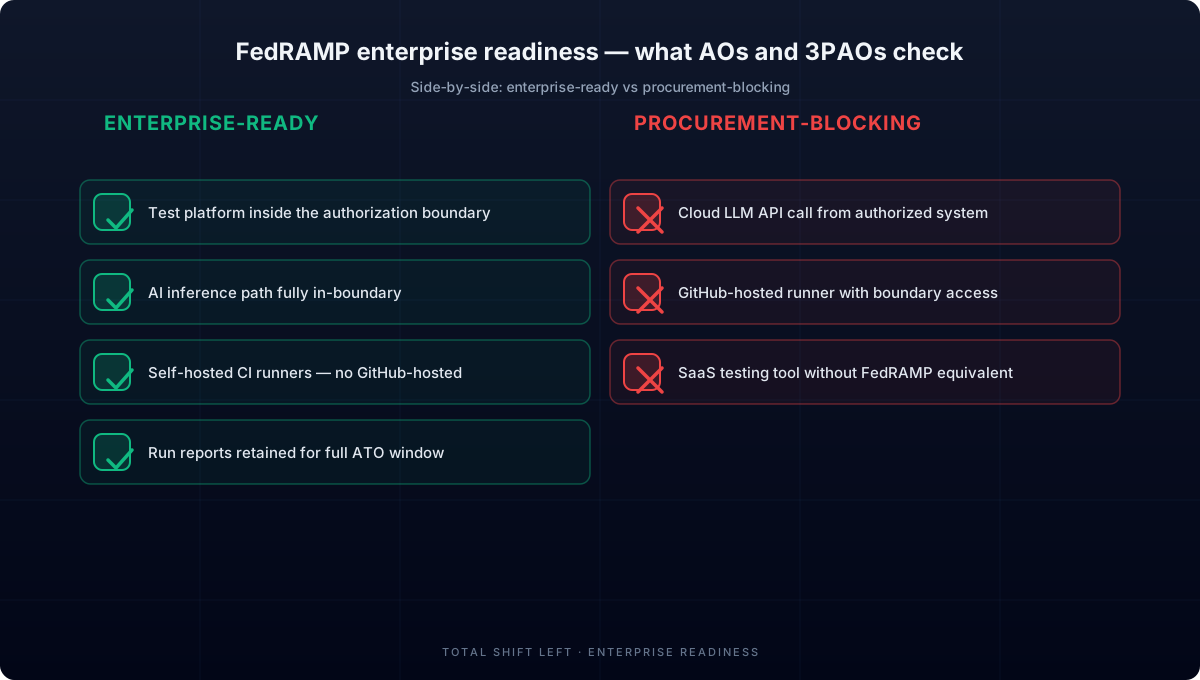
FedRAMP / NIST 800-53 — enterprise readiness checklist.
Reference architecture
A FedRAMP-aligned API testing architecture inherits the system's authorization boundary. The test platform runs on the same authorized infrastructure as the system under test, deployed via container images pulled from the internal registry that already serves the boundary. Self-hosted LLM runs on in-boundary GPU infrastructure — for FedRAMP Moderate, the open-source models available via Ollama and vLLM are typically sufficient; FedRAMP High and IL5+ require air-gapped operation. CI runners are self-hosted on the authorized infrastructure; GitHub-hosted runners are explicitly excluded. Run report retention uses GovCloud-eligible object storage with object-lock retention aligned to the authorization period (typically 3 years plus the continuous-monitoring window). SIEM integration captures audit events from the test platform and CI/CD into the existing system's log aggregation. The SSP narrative describes the architecture under SA-11, CM-3/CM-4, CA-7, and AU-2/AU-12 — the controls auditors map API testing evidence to. The architecture is deliberately sparse to minimize new authorization surface.
Metrics that matter
Three metrics matter to the AO and 3PAO. CA-7 continuous-monitoring coverage — percentage of authorized APIs with retained recurring test evidence — is the headline metric; 100% is the floor for a clean continuous-monitoring program. Boundary-leakage incidents — count of detected outbound calls from the test platform during the reporting period — should be zero; non-zero is a finding requiring remediation. SAR finding closure time — days from finding to documented remediation — measures the program's responsiveness; mature programs close routine findings inside 30 days. Report all three to the system owner, ISSO, and AO on the cadence the authorization specifies (typically monthly for active continuous monitoring).
Rollout playbook
FedRAMP-aligned rollout stretches across 16-20 weeks owing to authorization-boundary discipline. Weeks 1-3: boundary mapping. Document the existing authorization boundary. Identify where the test platform fits. Plan internal CI runner deployment. Weeks 4-6: in-boundary deployment. Stand up the platform on authorized infrastructure. Deploy self-hosted LLM. Verify zero outbound network egress with security-team support. Weeks 7-10: SSP integration. Update the SSP narrative under SA-11, CM-3/CM-4, CA-7, AU-2. Coordinate with the ISSO on language and evidence references. Weeks 11-14: pilot ATO. Run the first authorization cycle with the test platform integrated. Address SAR findings. Weeks 15-20: rollout. Onboard remaining authorized systems. Add the test platform to the system inventory. Establish continuous-monitoring cadence. Most agencies and contractors reach steady state by month 6; the timeline is bounded by authorization process more than by technical complexity.
Common challenges and how to address them
AI test generation requires a cloud LLM that has no FedRAMP equivalent. Switch to a self-hosted open-source LLM (Llama 3 / Qwen / Mistral) on Ollama / vLLM / LM Studio inside the boundary. Document the inference path in the SSP under SA-11.
CI runners are GitHub-hosted, outside the boundary. Migrate to self-hosted runners on authorized infrastructure. Document the CI architecture in the SSP under SA-11 and CM-3.
Test platform vendor doesn't have FedRAMP authorization. Deploy self-hosted inside the boundary; the platform inherits the boundary's ATO. Vendor SaaS need not be authorized when not used.
Continuous monitoring evidence is retained for 30 days then expires. Extend retention to the authorization period. Configure immutable storage. CA-7 requires retainable evidence for the full continuous-monitoring window.
Best practices
- Run the test platform inside the same authorized infrastructure as the system under test
- Use self-hosted LLM (Ollama / vLLM / LM Studio) for AI test generation; document under SA-11
- Use self-hosted CI runners — never GitHub-hosted runners for in-boundary test execution
- Retain continuous-monitoring evidence (CA-7) for the full authorization period in immutable storage
- Tag tests by NIST 800-53 control (SA-11, CM-3, AU-2, AC-3) for SSP-mapped reporting
- Update the SSP narrative whenever the inference path or CI architecture changes
- Document the "fail closed" behavior of any AI inference path in the security questionnaire
Implementation checklist
A pre-flight checklist enterprise teams can run against their current state:
- ✔ Test platform runs on authorized infrastructure inside the boundary
- ✔ AI inference path is fully self-hosted with no outbound calls
- ✔ CI runners are self-hosted on authorized infrastructure
- ✔ Run reports are retained immutably for the full authorization period
- ✔ Tests carry tags mapping each to one or more NIST 800-53 controls
- ✔ The SSP describes the testing program under SA-11, CM-3, CA-7, AU-2
- ✔ Audit log captures test execution at production-equivalent fidelity
- ✔ Quality gates block promotion on coverage / contract / security violations
See also: jwt authentication in our learn hub for the underlying concept.
Conclusion
FedRAMP-aligned API testing is mostly about boundary discipline. The path of least resistance — self-hosted platform, self-hosted LLM, in-boundary CI — eliminates most of the questions an AO will ask and shortens the SSP narrative materially. Vendors that get this right pass through SAR and ATO without remediation cycles. Vendors that don't end up rebuilding the architecture mid-process and burning quarters on it.
FAQ
Is API testing required for FedRAMP authorization?
FedRAMP does not name "API testing" as a control, but NIST SP 800-53 controls in the SA, CM, AU, and AC families effectively require it for any system whose APIs handle federal information. The SSP is where you describe how API testing implements those controls.
Does the testing tool need its own ATO?
Only if it processes federal information or sits inside the authorization boundary. A self-hosted tool inside your boundary inherits the boundary's ATO. A SaaS testing tool would need its own FedRAMP authorization at the equivalent impact level — which most do not have at IL4+ levels.
Can AI test generation work in FedRAMP environments?
Only if the inference path is fully inside the authorization boundary. Cloud LLM APIs (OpenAI, Anthropic, Google) almost never carry the equivalent authorization, so AI-assisted testing for FedRAMP-Moderate and above generally requires a self-hosted LLM (Ollama, vLLM, LM Studio) running on the same authorized infrastructure as the test platform.
How do API tests appear in the SSP?
Typically as evidence under SA-11 (developer testing and evaluation), CM-3 / CM-4 (change control), AU-2 / AU-12 (audit events), and CA-7 (continuous monitoring). The SSP narrative describes the cadence and the evidence retention window; the artifacts (test definitions, run reports, coverage data) live in the system inventory referenced from the SSP.
Ready to shift left with your API testing?
Try our no-code API test automation platform free.