
API Testing for PCI-DSS Compliance: Cardholder Data, SAQ Scope & Audit Evidence (2026)
How API testing programs satisfy PCI-DSS v4.0.1 controls without expanding cardholder-data scope. Tokenization-aware test fixtures, in-scope vs out-of- scope tooling, and a control-mapping cheat sheet for payment teams.
What is this
API testing for PCI-DSS compliance is the practice of validating payment APIs that handle Primary Account Numbers (PANs), full track data, CAV2/CVC2/CVV2/CID values, or PIN data — while keeping the testing toolchain itself out of Cardholder Data Environment (CDE) scope. It covers internal payment APIs, integrations with card networks and payment processors, and the CI/CD pipeline that runs the tests. The goal is to satisfy v4.0.1 Requirement 11 (security testing) and Requirement 6 (secure development) with retained evidence per release, without expanding CDE scope.
Key components
Each enterprise program in this area has the same load-bearing components, regardless of vendor. The components separate cleanly into governance, enforcement, and evidence layers.
CDE scope discipline
The test environment runs in a network segment that does not store, process, or transmit live cardholder data. Captured request and response payloads are scanned for PAN-shaped data and rejected if any is detected. Test fixtures use synthetic PANs (network-issued test cards) or tokenized references resolvable only by the production tokenization vault.
Self-hosted AI inference
AI test generation runs on a self-hosted LLM inside the same network segment as the test platform — never on a cloud LLM API that would expose payment-API OpenAPI specs to a third-party processor. Most QSAs treat OpenAPI specs sent to a public LLM as a scope-affecting event.
Short-lived test credentials
Service-account tokens issued per test run from a vault, never persisted in source control or build artifacts. Long-lived test credentials are eliminated; the lifetime of any test credential is measured in hours, not months.
Captured-payload PAN scanner
A regex-based PAN detector runs against every test artifact and CI build product. Any hit fails the build and triggers incident response. The scanner is the safety net for sandbox environments that accidentally retain real PANs.
Requirement 11 evidence
Recurring API security test suites produce retained run reports tied to the change-management ticket. Reports are stored in immutable storage with retention aligned to the assessment window. The evidence chain — change ticket → test run → release approval — is what QSAs sample during assessment.
Cross-mapping to v4.0.1
Tests are tagged by PCI-DSS requirement (6.2, 6.5, 11.3, 11.4) so reports can be filtered by requirement during QSA evidence requests. The same testing program serves multiple requirements without parallel work.
Table of Contents
- How PCI-DSS scope works for API testing programs
- Three CDE-adjacent risks specific to API tests
- Test data patterns that keep tools out of scope
- PCI-DSS v4.0.1 control mapping
- What QSAs actually ask for
- Reference architecture for payment API testing
How PCI-DSS scope works
PCI-DSS scope is defined by where cardholder data lives, moves, and is processed. The Cardholder Data Environment (CDE) extends to every system, network segment, and process that touches Primary Account Numbers (PANs), full track data, CAV2/CVC2/CVV2/CID values, or PIN/PIN block data. Anything in scope is subject to the full set of v4.0.1 requirements.
API testing fits into this picture in three ways:
- The APIs themselves that move cardholder data are in scope and require testing.
- The testing tools are in or out of scope depending on whether they ever touch real cardholder data — including in test fixtures, captured request/response payloads, or AI-inference inputs.
- The CI/CD pipeline that runs the tests is in or out of scope based on the same criteria.
The cheapest, most defensible posture is to keep the testing tooling out of CDE scope by design. That means tests run against tokenized or synthetic data, captured payloads never contain real PANs, and the inference path for any AI-assisted test generation stays inside the boundary you already manage — most easily achieved with a runner that executes tests entirely inside your own network segment.
Three CDE-adjacent risks
Spec-level disclosure. OpenAPI / WSDL specs for payment APIs describe the cardholder-data fields explicitly — PAN, expiry, CVV, cardholder name. A spec sent to a cloud LLM for AI test generation discloses your CDE shape. Most QSAs treat this as a scope-affecting event even though no live PAN is sent.
PAN in captured payloads. Test runs against a sandbox environment frequently capture full request and response bodies for debugging. If the sandbox uses real PANs (which Requirement 6.5.5 prohibits — but which still happens) or if production traffic accidentally leaks into the captured corpus, the test platform now stores cardholder data and is fully in CDE scope.
Long-lived test credentials. Service-account tokens used by test pipelines often have payment-API access broader than any human user. Leaked into a CI log, source-control secret, or test artifact, they become a scope-affecting incident.
Test data patterns out of scope
The cleanest patterns for keeping API testing tooling out of PCI-DSS scope:
| Pattern | How it stays out of scope |
|---|---|
| Synthetic PANs (e.g. test cards from card networks) | No live cardholder data ever exists in the test environment |
| Tokenized references | Tests use opaque tokens; only the production tokenization service can resolve them |
| Format-preserving masking | Replaces real PANs with structurally similar but invalid card numbers |
| Sandbox APIs from payment providers | Test against Stripe / Adyen / Worldpay / Braintree sandboxes — those vendors handle scope |
In all cases, the AI test generation path needs the same scope discipline: a self-hosted LLM running inside the same boundary as the test runner, with no outbound inference calls.
Ready to shift left with your API testing?
Try our no-code API test automation platform free. Generate tests from OpenAPI, run in CI/CD, and scale quality.
For deeper coverage of these patterns see data masking for regulated test environments and test data management for regulated data.
PCI-DSS v4.0.1 control mapping
| Requirement | What API testing provides |
|---|---|
| 6.2.1 — secure software development | Source-controlled test definitions; per-release test execution as part of the SDLC |
| 6.2.4 — code review for in-scope code | Test runs catching schema drift and contract violations on payment APIs pre-release |
| 6.3.2 — software inventory | Test catalog mapping APIs to environments and endpoints |
| 6.5.5 — no live PANs in test | Fixtures and masking pipeline confirming live PANs never enter the test environment |
| 11.3 — vulnerability scans and pen tests | Recurring API security test suites with retained reports |
| 11.4 — intrusion detection equivalents on API surface | Negative authentication and authorization tests on every cardholder-data API |
| 12.10 — incident response | Logged audit trail of who ran which test against which environment |
A QSA does not expect every requirement to map to a specific test. They expect to see a documented program where API testing is named in the testing strategy, executed on a defined cadence, and produces evidence retained for the audit window.
What QSAs actually ask for
In a v4.0.1 assessment, expect questions on:
- The list of in-scope APIs (the ones that handle cardholder data) and the test suite covering each
- Sample test execution reports from the last release of each in-scope API
- Evidence that test fixtures contain no live PANs
- The change-management record connecting test approval to release
- Role assignments and audit log entries for the test environment
- Documentation of the AI test generation path — specifically whether any data leaves the CDE during inference
The last item is increasingly common as QSAs encounter AI-augmented testing for the first time. Self-hosted-LLM deployment makes that conversation short.
Reference architecture
A reference architecture for PCI-DSS-aligned API testing:
- Self-hosted test platform in a network segment that does not store, process, or transmit live PANs.
- Self-hosted LLM (Ollama, vLLM, LM Studio) for AI-assisted test generation; no outbound model API calls.
- Synthetic / tokenized fixtures generated in-boundary; sandbox APIs from payment providers used wherever possible.
- Source-controlled test definitions in a repository segregated from CDE code.
- CI/CD integration producing exportable run reports retained for the audit window.
- Role-based access for QA engineers, developers, and security reviewers — every action logged.
Banks and payment processors increasingly require this architecture before authorizing any AI-assisted testing tool. For deployment topology that supports it directly, see the deployment page and the banking industry page.
PCI-DSS v4.0.1 does not name API testing as a specific control, but the rule's expectations on secure SDLC, vulnerability management, and CDE scope discipline make a documented API testing program effectively required for any payment-handling team. The bar that v4.0.1 raises — and that QSAs increasingly enforce — is on AI-assisted tooling: the inference path has to demonstrably stay inside the CDE boundary or the tool falls fully into scope.
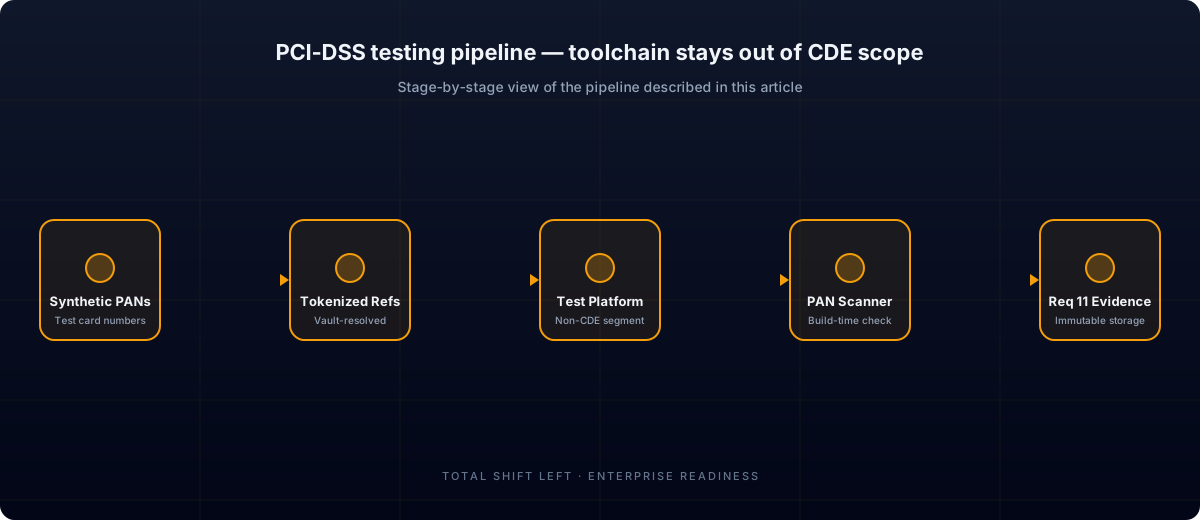
PCI-DSS-aligned API testing pipeline — keeping the testing toolchain out of CDE scope.
Why this matters at enterprise scale
Verizon's 2024 Payment Security Report tracked 175,000+ PCI-DSS assessments and found that organizations failing Requirement 11 (security testing) accounted for a disproportionate share of compromise events the following year. With PCI-DSS v4.0.1 raising the bar on continuous validation and explicit AI-related scope concerns, payment teams now face documented testing as a precondition for assessment success — not a nice-to-have.
Tools landscape
A practical view of the tool categories that scale across enterprise testing programs in this area:
| Category | Example tools |
|---|---|
| Tokenization platforms | Stripe, Adyen, Worldpay, Braintree sandboxes — keep CDE scope contained |
| Synthetic PAN generators | Card-network test card lists, Faker-based generators with Luhn validation |
| API security scanning | OWASP ZAP, Burp Suite Enterprise, Total Shift Left contract + security tests |
| Audit evidence retention | AWS S3 Object Lock, Azure Immutable Blob, GCP Bucket Lock |
| Secret scanning (Req 6.5) | TruffleHog, GitGuardian, GitHub secret scanning |
Tool selection is secondary to architecture. The patterns above hold regardless of which specific vendor you adopt.
Real implementation example
A representative deployment pattern from an enterprise rollout in this area:
Problem. A mid-market acquirer running ~120 internal APIs serving merchant onboarding and transaction processing failed the v4.0.1 transition assessment. The QSA cited insufficient evidence of pre-release security testing on payment APIs and concerns that the team's AI test generation tool was sending OpenAPI specs to a public LLM API.
Solution. The team migrated to a self-hosted API testing platform with self-hosted LLM (vLLM behind the existing CDE network segment). Test fixtures moved to tokenized references resolvable only via the production tokenization vault. PCI-DSS Requirement 11 evidence — recurring API security tests with retained run reports — was tied directly into the change-management ticket.
Results. Re-assessment closed within 90 days with no Requirement 11 or 6 findings. The QSA praised the AI inference path as "the cleanest we've seen this assessment cycle." Security regression rates on payment APIs dropped 40% over the next two release trains.
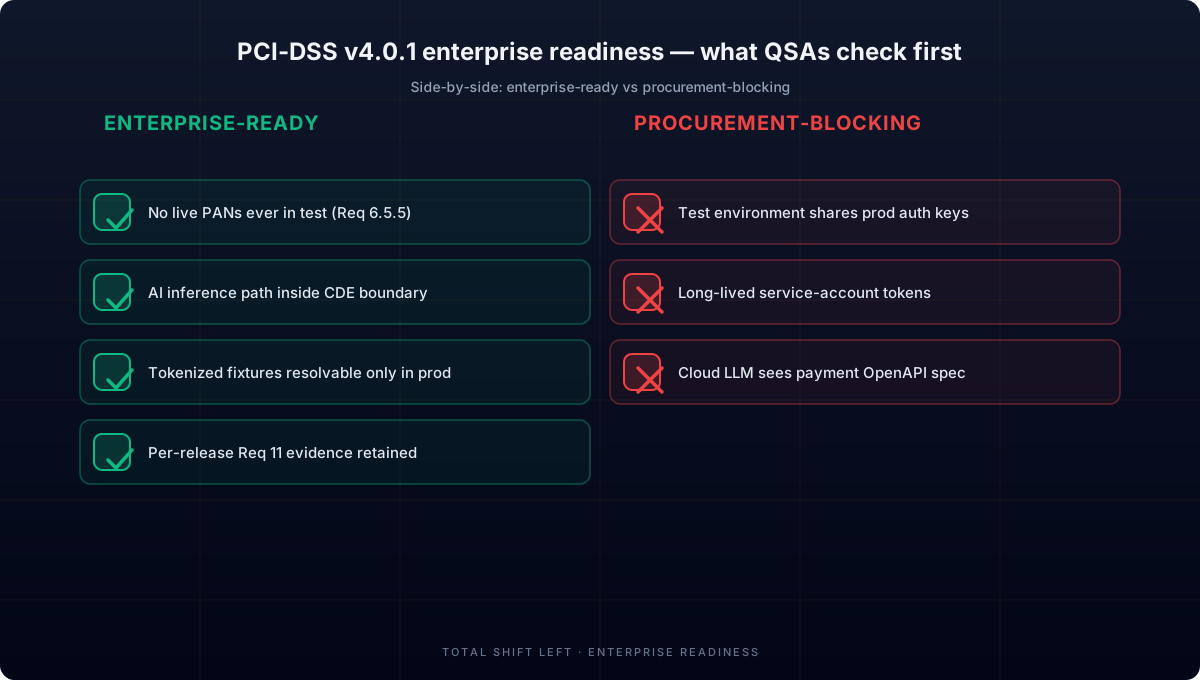
PCI-DSS-aligned API testing — enterprise readiness checklist.
Reference architecture
A PCI-DSS-aligned API testing architecture keeps the testing toolchain entirely out of CDE scope by design. Network segmentation places the test platform in a non-CDE network segment, with documented absence of cardholder-data flows. Tokenization integration lets tests use opaque tokens resolvable only by the production tokenization vault — fixtures contain no PANs. AI inference runs on a self-hosted LLM (Ollama, vLLM, or LM Studio) inside the existing organizational boundary, with documented fail-closed behavior on local-endpoint outage. Captured-payload scanning runs on every test artifact pre-storage — a regex-based PAN detector that fails the build on any hit, ensuring real PANs never persist even if a sandbox accidentally returns them. Run report retention uses immutable object storage with retention aligned to the assessment window. Audit log aggregation flows into the existing SIEM. Each component is scoped to keep the testing toolchain firmly out of scope rather than relying on after-the-fact masking.
Metrics that matter
Four metrics matter to the QSA cycle. CDE-adjacent API test coverage — percentage of payment-API endpoints with retained Requirement 11 evidence — is the assessment-facing metric; 95%+ is the practical floor. Captured-payload PAN detection rate — count of attempted commits caught by the scanner — should trend down over time as engineering culture adapts. Test-credential rotation cadence — average lifetime of a test service-account credential — should be measured in hours, not months; rotation per test run is the modern default. AI inference path verifications — count of confirmed fail-closed events when the local LLM endpoint was unreachable — should be non-zero (rare but observed); zero may indicate the failure mode is untested rather than absent. Report on a quarterly cadence to the QSA and security leadership.
Rollout playbook
Payment teams typically execute a 14-week rollout. Weeks 1-3: foundation. Provision the test platform in a non-CDE segment with self-hosted LLM. Verify network egress rules block all outbound paths. Integrate with tokenization vault. Weeks 4-6: scope discipline. Migrate fixtures to tokenized references. Deploy captured-payload PAN scanner on all CI artifact paths. Rotate test credentials to short-lived per-run pattern. Weeks 7-10: rollout. Onboard payment-API teams in order: card-not-present (highest scope), recurring billing, settlement, refunds. Configure CI quality gates for Requirement 11 evidence retention. Weeks 11-14: assessment readiness. Document the architecture in the QSA evidence packet — network diagrams, tokenization flow, AI inference path, captured-payload scanner reports. Run a mock assessment against the documented evidence to surface gaps. Most teams clear 95% coverage by month 5 and pass the next QSA cycle without Requirement 11 or 6 findings.
Common challenges and how to address them
Sandbox environments accidentally retain real PANs from leaked production traffic. Add a captured-payload scanner that runs against test artifacts and fails the build on PAN regex hits. Remediate any historical artifacts under formal incident response.
Long-lived test service-account tokens have payment-API scope broader than any human user. Rotate to short-lived credentials issued per test run from a vault. Tokens never persist in source control or build artifacts.
AI test generation tool sends spec to cloud LLM by default. Configure self-hosted LLM and verify "fail closed" on local endpoint outage — never silent fallback. Document in the QSA evidence packet.
Test environment shares an auth server with production. Segment auth servers per environment with distinct signing keys. Treat any shared key as a scope-affecting incident.
Best practices
- Use synthetic PANs (test cards) or tokenized references only — never live PANs in test
- Run AI inference inside the CDE boundary; verify no outbound LLM API calls during a test run
- Capture and retain Requirement 11 evidence (test runs, coverage, gate decisions) in immutable storage
- Enforce per-tenant rate limits and authorization tests on every cardholder-data API
- Rotate test credentials per run; never persist tokens in source control or CI logs
- Tag tests by PCI-DSS requirement (6.2, 6.5, 11.3, 11.4) for assessment-mapped reporting
- Document the test data-flow as part of the QSA evidence packet, not just internal docs
Implementation checklist
A pre-flight checklist enterprise teams can run against their current state:
- ✔ Test environment is isolated from CDE; no real PANs ever enter test
- ✔ AI inference path is fully self-hosted with documented "fail closed" behavior
- ✔ Per-release test execution evidence is retained for the assessment window
- ✔ Negative authentication and authorization tests cover every cardholder-data API
- ✔ Test service-account tokens are short-lived and rotated per run
- ✔ A documented mapping from test artifacts to PCI-DSS v4.0.1 requirements exists
- ✔ Captured payload scanner blocks any PAN-shaped data from entering build artifacts
- ✔ Audit trail of test execution is captured at the same fidelity as production access
See also: jwt authentication in our learn hub for the underlying concept.
Conclusion
PCI-DSS v4.0.1 raises the bar on documented security testing of payment APIs and on the AI-tooling scope question. Payment teams that resolve both — self-hosted platform, self-hosted LLM, tokenized fixtures, immutable evidence retention — meaningfully reduce both assessment friction and breach exposure. The teams that don't end up either failing assessments or running parallel tooling that QSAs eventually disallow.
FAQ
Does API testing put my testing tool in PCI-DSS scope?
It depends entirely on whether the tool processes, stores, or transmits cardholder data — including in captured request and response payloads from a test run. A tool that runs against tokenized fixtures with no real PAN ever crossing into the test environment stays out of scope. A tool that captures payloads from a CDE-adjacent environment is in scope.
Can I use real PANs in test data?
PCI-DSS Requirement 6.5.5 prohibits the use of live PANs for testing. Test environments must use either fully synthetic card numbers or tokenized references. Format-preserving masking that retains real PAN structure is acceptable only if the result is not a valid PAN.
How do API tests provide PCI-DSS Requirement 11.3 evidence?
Requirement 11.3 (vulnerability scanning and penetration testing) expects regular validation of internet-facing systems and authenticated test surfaces. API security test suites that run on every release and produce retained reports are commonly cited as part of that evidence — particularly for in-house developed payment APIs and integrations.
Does AI test generation create new PCI-DSS issues?
Yes if the tool sends OpenAPI specs or captured payloads to a cloud LLM. The spec describes the cardholder-data flow, and that information leaving the CDE is itself a scope event in many QSAs' interpretation. Self-hosted LLMs (Ollama, vLLM, LM Studio) avoid this by keeping inference inside the CDE boundary.
Ready to shift left with your API testing?
Try our no-code API test automation platform free.