
API Testing for SOC 2 Audits: Mapping Tests to Trust Service Criteria (2026)
Which SOC 2 Trust Service Criteria are evidenced by API testing, what the artifacts look like, and how to design a program that reduces auditor back- and-forth. Worked control mappings for CC7, CC8, and Availability.
What is this
API testing for SOC 2 audits is the practice of designing, executing, and retaining API test artifacts so they demonstrably evidence the Trust Service Criteria (TSC) the organization is being audited against — most commonly CC6 (logical access), CC7 (system operations), CC8 (change management), and Availability A1.x. It applies to both Type I (point-in-time control design) and Type II (operating effectiveness over a period) reports, with materially higher evidence-retention demands for Type II.
Key components
Each enterprise program in this area has the same load-bearing components, regardless of vendor. The components separate cleanly into governance, enforcement, and evidence layers.
Source-controlled test definitions
Tests live in git with branch protection, signed commits, and required code review. Auditors evaluate the suite's evolution over time; the change history is part of the evidence. UI-authored tests without versioning don't pass Type II review.
Run-report retention
JUnit XML / JSON output from every CI run flows to immutable object storage (S3 Object Lock, Azure Immutable Blob, GCS Bucket Lock) with retention policy aligned to the SOC 2 reporting period plus a buffer. CI artifacts that auto-expire after 30 days fail Type II sampling.
TSC tagging convention
Tests carry tags mapping to the Trust Service Criteria they evidence — cc6-1, cc7-1, cc7-2, cc8-1, a1-2, c1-1. Reports filter by tag for control-mapped reporting, eliminating the need to rewrite the suite per audit.
Coverage delta per release
A coverage report is attached to every change ticket showing what changed, what tests covered the change, and how coverage moved before / after. This is the highest-leverage artifact for Type II sampling — auditors anchor on it.
Audit-log capture
The test platform emits audit events into the SIEM that already serves SOC 2 — who ran which test against which environment, when. Records are retained for the audit window and queryable by date / API / control area.
Audit interface
A thin service over the centralized aggregation that auditors can query directly — by date, by API, by control. Programs that ship the audit interface report Type II audit cycles 30-50% shorter than programs that hand-assemble evidence per audit.
Table of Contents
- What SOC 2 actually requires from API testing
- Mapping API tests to Trust Service Criteria
- Type I vs Type II evidence differences
- Designing tests to be auditor-friendly
- Reference architecture
What SOC 2 actually requires
SOC 2 differs from regulations like HIPAA or PCI-DSS in that it does not prescribe specific controls. Instead, it asks whether the controls you have selected are designed appropriately and operating effectively against the Trust Service Criteria (TSC) in scope.
For most B2B SaaS organizations, that translates into a set of common selections:
- Detect security events on production APIs (CC7.x)
- Validate changes before they reach production (CC8.x)
- Limit logical access to authorized users (CC6.x)
- Meet committed availability targets (A1.x)
- Protect confidential information (C1.x where Confidentiality is in scope)
API testing is one of the cleanest ways to demonstrate the CC7 and CC8 selections in particular. The auditor's question is essentially: "How do you know production APIs behave as committed?" The answer that scales is "We have a documented test program that runs on every change, here are the run reports."
Mapping to Trust Service Criteria
A practical mapping for a typical B2B SaaS scope:
| TSC | Common selection | API testing evidence |
|---|---|---|
| CC6.1 — logical access security | Authn/authz on production APIs | Negative authentication and authorization tests; tests across enterprise IdP flows (Okta, Azure AD, Ping) |
| CC6.7 — restrict transmission of confidential information | TLS, scope-limited tokens | TLS configuration tests; tests confirming no confidential field is returned in error paths |
| CC7.1 — detect security events | Monitoring + change detection | Contract tests that detect schema drift; coverage reports showing untested endpoints |
| CC7.2 — system anomaly detection | Test failures gating release | CI quality gates on coverage and pass rate |
| CC8.1 — manage changes | SDLC controls | Per-release test reports linked to change tickets; source-controlled test definitions |
| A1.2 — environmental, software, and data backups | Availability monitoring | API health and SLA tests with retained run history |
| C1.1 — confidentiality | Field-level access | Contract tests asserting confidential fields appear only in authorized responses |
A SOC 2 program does not require one test per criterion. It requires a credible, retained, sampleable relationship between the testing activity and the TSC the auditor is examining — the kind of relationship a matrix that maps each control to the tests evidencing it makes trivial to produce on demand.
Type I vs Type II evidence
A SOC 2 Type I report attests that controls are designed appropriately at a point in time. A Type II report attests that controls operated effectively over a period (commonly six or twelve months). The evidence demands are different:
Ready to shift left with your API testing?
Try our no-code API test automation platform free. Generate tests from OpenAPI, run in CI/CD, and scale quality.
- Type I: Documented testing program, sample test definitions, sample run report, list of API surfaces in scope.
- Type II: All of the above, plus retained run reports across the entire audit period, change-management records linking releases to test runs, and audit logs showing who ran what when.
Most teams underestimate Type II evidence requirements. Run reports must be retained — not regenerated on demand — for the auditor's sampling. Tests run from a CI pipeline that overwrites artifacts every day will not pass Type II sampling. Exportable, immutable, dated run reports retained for the audit window are the right pattern.
Designing tests to be auditor-friendly
Three design choices that reduce auditor back-and-forth:
Source-control everything. Test definitions in git, with branch protection and a change history, give auditors a verifiable audit trail of how the test suite evolved. Tests authored ad-hoc in a UI without versioning create gaps.
Tag tests by control area. A simple convention — cc7-1, cc8-1, a1-2 tags or labels on test cases — lets you produce control-mapped reports without rewriting the suite. The auditor can see at a glance which tests evidence which criterion.
Retain coverage deltas per release. A coverage report attached to each change ticket showing what changed, what tests covered the change, and what coverage looked like before and after gives the auditor a sampling anchor. This is the single highest-leverage artifact for a clean Type II audit.
For coverage tracking patterns, see how to measure API test coverage. For CI pipeline integration patterns, see API security testing in enterprise SDL & CI/CD.
Reference architecture
A SOC 2-friendly API testing architecture has five elements:
- Source-controlled test definitions in a repository with branch protection and change history.
- CI/CD integration that runs tests on every PR and release, producing exportable run reports.
- Run report retention for the full audit window — typically S3, GCS, or equivalent with object lock or write-once storage class.
- Audit log of test executions: who, what, when, against which environment.
- Coverage tracking with per-release deltas surfaced on change tickets.
When deployment posture matters (regulated SaaS, single-tenant private cloud, on-prem), all five components run inside the boundary that holds the Confidentiality and Privacy criteria. See the security page for platform-level posture and the deployment page for topology options.
SOC 2 does not require API testing by name, but the Common Criteria around change management and system operations are most credibly evidenced by a documented, retained, source-controlled API testing program. The architecture work that pays off is making test artifacts queryable and sampleable months after the test ran — the difference between a clean Type II and a noisy one.
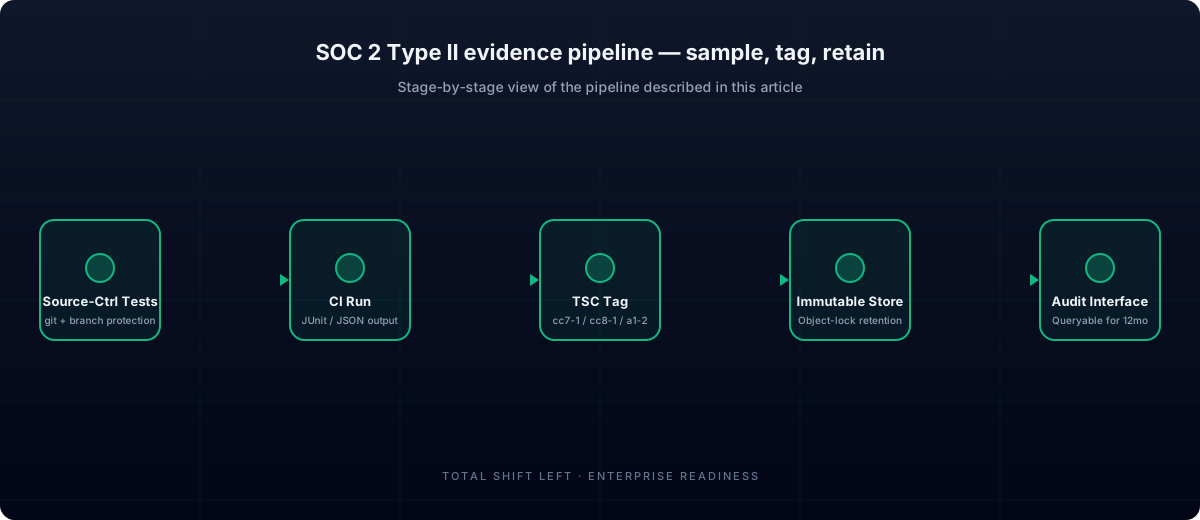
SOC 2-aligned API testing evidence pipeline — sample, tag, retain.
Why this matters at enterprise scale
SOC 2 Type II reports increasingly include API testing as named evidence under CC7 and CC8 — and AICPA's 2024 Trust Services Criteria guidance signals that auditors will continue tightening scrutiny of automated change-validation in 2026. Organizations that ship a documented, retained API testing program report Type II audit cycles 30-50% shorter than those that hand-assemble evidence per audit, on benchmarks shared by major attestation firms.
Tools landscape
A practical view of the tool categories that scale across enterprise testing programs in this area:
| Category | Example tools |
|---|---|
| Test definition / source control | GitHub, GitLab, Bitbucket with branch protection and signed commits |
| Run report retention | AWS S3 Object Lock, Azure Immutable Blob, internal artifact servers with retention policy |
| Coverage tracking | Total Shift Left coverage dashboards; Codecov for code coverage tie-in |
| Quality gates | CI/CD plugins with pass-rate and coverage-floor thresholds |
| Audit log aggregation | Splunk, Datadog, Elastic — pulled into the SIEM that already serves SOC 2 |
Tool selection is secondary to architecture. The patterns above hold regardless of which specific vendor you adopt.
Real implementation example
A representative deployment pattern from an enterprise rollout in this area:
Problem. A B2B SaaS organization preparing for its first SOC 2 Type II audit (CC7 + CC8 in scope) had test execution but no retention. Run reports lived in CI for 30 days then auto-expired. The auditor's sample for change-management evidence across the 12-month window failed because most referenced runs no longer existed.
Solution. The platform team added an evidence aggregation layer that pulled JUnit/JSON run reports from CI on every build and persisted them to immutable object storage with the release record. Tests were tagged by control area (cc7-1, cc8-1). Coverage deltas were attached to every change ticket.
Results. The Type II audit closed cleanly with no CC7 or CC8 findings. Auditor sampling time dropped from 15 days to under 4. Engineering effort during the next audit cycle was minimal — the aggregation served the auditor's queries directly without engineer involvement.
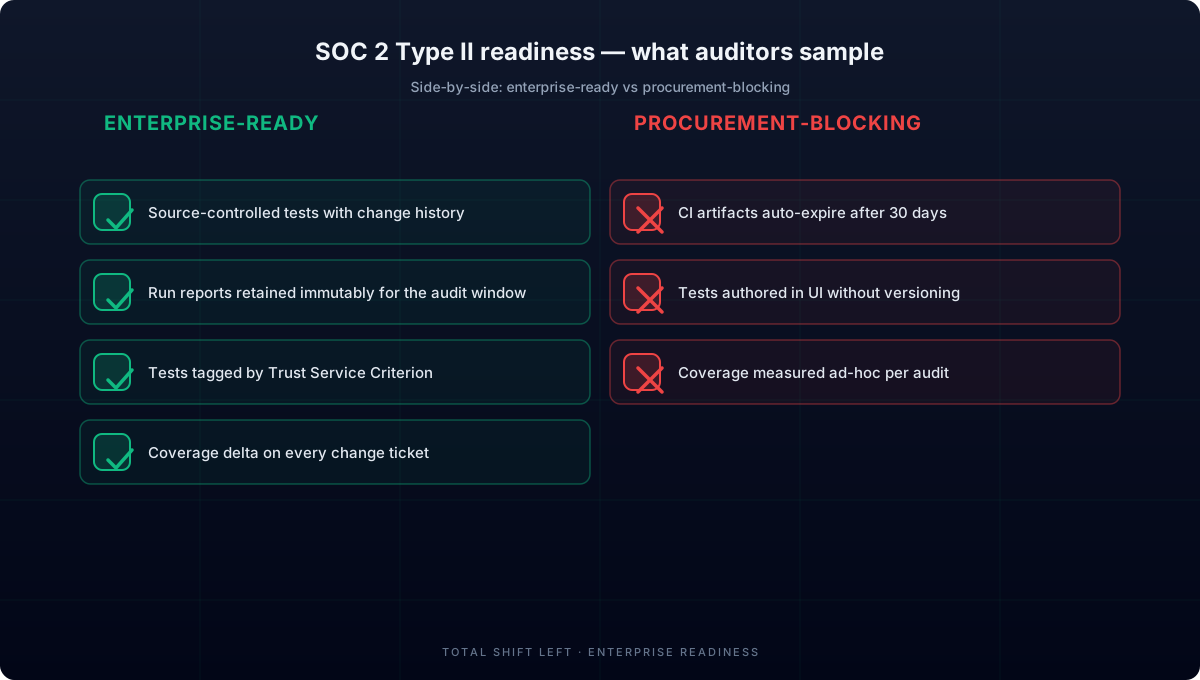
SOC 2 Trust Service Criteria — enterprise readiness checklist.
Reference architecture
A SOC 2-friendly API testing architecture is mostly an evidence-retention design. Test definitions live in source control with branch protection, signed commits, and a verifiable change history — auditors evaluate the suite's evolution. Run report emission generates JUnit XML and JSON on every CI run; a copy-to-immutable-storage step persists the artifact to object storage with object-lock enabled and retention policy aligned to the SOC 2 reporting period plus a buffer. Tagging convention marks each test with the TSC criterion(a) it evidences (cc6-1, cc7-1, cc8-1, a1-2); reports filter by tag. Coverage tracking captures per-release deltas and attaches them to change tickets — the single highest-leverage artifact for Type II sampling. Audit log capture records who ran which test against which environment; the log flows into the same SIEM that already serves SOC 2. Audit interface is a thin service over the aggregation, queryable by date / API / control area; auditor queries hit it directly without engineer involvement. The architecture is unremarkable — the discipline is in retention.
Metrics that matter
Three metrics dominate the SOC 2 conversation with executive sponsors. Type II evidence completeness — percentage of releases in the audit window with full retained evidence — must sit at 100% for a clean audit; gaps surface as findings. Auditor sampling time — calendar days from auditor request to evidence delivery — is the operational metric; mature programs deliver in under 5 days versus weeks for ad-hoc programs. Coverage delta visibility — percentage of change tickets with attached coverage delta — is the leading indicator; programs that hit 100% on this metric pass Type II sampling without back-and-forth. Report all three to engineering and compliance leadership on a quarterly cadence; surface anomalies to the audit committee.
Rollout playbook
A 10-week rollout aligns most B2B SaaS teams to Type II readiness. Weeks 1-2: source control. Migrate any UI-authored test definitions to source control. Add branch protection and required code review. Weeks 3-4: retention. Build the evidence-pull pipeline that copies CI artifacts to immutable object storage. Verify retention policy. Weeks 5-6: tagging. Add TSC tags to existing tests. Generate sample tag-filtered reports. Validate that auditor-style queries return correct results. Weeks 7-8: coverage delta. Wire coverage measurement into the change-ticket integration. Confirm every release ticket gets a delta attachment. Weeks 9-10: audit interface. Stand up the queryable interface over the aggregation. Run a mock auditor query workflow. Identify and close any retention gaps. Most teams enter their first Type II audit cycle by month 3-4 and complete clean by month 8-10.
Common challenges and how to address them
CI artifacts auto-expire before the audit window closes. Add an evidence-pull step at the end of every pipeline that copies JUnit/JSON results to immutable storage. Retain for the SOC 2 reporting period plus a buffer.
Test definitions live in a UI without version history. Migrate to source-controlled test definitions. Auditors expect a verifiable audit trail of how the test suite evolved.
Engineers can't map tests to TSC criteria. Adopt a tagging convention (cc6-1, cc7-1, cc8-1, a1-2). Tests carry their control mapping; reports filter by tag.
Auditor asks for evidence that fixes worked, not just that tests existed. Retain the failing run plus the subsequent passing run linked to the change ticket. The transition is the evidence.
Best practices
- Source-control every test definition with branch protection
- Retain JUnit/JSON run reports in immutable storage for the full audit window
- Tag tests by TSC tag (cc6-1, cc7-1, cc8-1, a1-2) for control-mapped reporting
- Attach coverage deltas to every change ticket for sampling anchors
- Run quality gates on coverage floor and pass rate; document waivers when used
- Capture audit-log entries for who ran which test against which environment
- Document the testing program in the SOC 2 description of services
Implementation checklist
A pre-flight checklist enterprise teams can run against their current state:
- ✔ Test definitions live in source control with change history
- ✔ Run reports are retained immutably for the SOC 2 reporting period
- ✔ Tests carry tags mapping each to one or more Trust Service Criteria
- ✔ Coverage delta is attached to every release / change ticket
- ✔ Audit log captures test execution at production-equivalent fidelity
- ✔ Quality gates block release on coverage drop or pass-rate regression
- ✔ A documented mapping from test artifacts to CC6 / CC7 / CC8 / A1 exists
- ✔ The SOC 2 system description names the testing program and its cadence
Take the next step. See how regulated-industry API testing applies these ideas to your workflow, or explore on-premise deployment options for the broader picture.
See also: jwt authentication in our learn hub for the underlying concept.
Conclusion
SOC 2 evidence quality is mostly an architecture decision: source control your tests, retain your reports immutably, tag for the criteria you're audited against, and surface coverage on every change ticket. Organizations that get this right ship cleaner Type II reports with materially less engineering time consumed per audit cycle. Organizations that don't end up assembling evidence by hand on every audit and missing CC7/CC8 controls in the process.
FAQ
Does SOC 2 require API testing?
SOC 2 doesn't prescribe controls; it asks whether the controls you have in place meet the Trust Service Criteria you're being audited against. For most SaaS organizations, API testing is the most defensible evidence of CC7.1 (detect anomalies) and CC8.1 (manage changes) for production APIs.
Which TSCs are most often evidenced by API tests?
Common Criteria CC6 (logical access), CC7 (system operations / change detection), CC8 (change management), plus Availability A1.2 if your product offers SLAs. Confidentiality C1.1 also benefits from contract-level tests that confirm sensitive fields are not exposed.
What does an auditor expect to see for a Type II SOC 2?
A retained, queryable record of test executions across the audit period, linking each in-scope production change to a corresponding test run that approved it. Sampling-friendly evidence — exportable run reports, version-controlled test definitions, and audit logs of who ran what — beats a "we test on every release" assertion.
How do I prove tests covered the right things?
Coverage tracking that shows endpoint, method, status code, and contract coverage with per-release deltas. A coverage report attached to the change ticket gives the auditor a sampling anchor without requiring them to read individual test cases.
Ready to shift left with your API testing?
Try our no-code API test automation platform free.