
Enterprise Test Management Strategy: From Tools to Outcomes (2026)
How enterprise QA leadership designs a test management strategy that scales across hundreds of services, holds up to audit, and doesn't collapse into a tool-of-the-month problem. Frameworks, RACI patterns, and the metrics that matter.
What is this
Enterprise test management strategy is the operating model that defines who owns testing across hundreds of services, what evidence is produced, and how the QA function organizes around audit readiness rather than test execution. The 2026 model — increasingly converged across regulated enterprises — has engineering owning test execution for the code they own, and the QA function owning standards, the audit interface, and complex-flow / exploratory testing that doesn't automate cleanly.
Key components
Each enterprise program in this area has the same load-bearing components, regardless of vendor. The components separate cleanly into governance, enforcement, and evidence layers.
Engineering-owned test execution
Tests live with the code they validate — in source control beside the code, run in the team's CI, evidence flows to the central aggregation. Backend, platform, and security teams own their respective test surfaces.
QA-owned standards
Coverage minimums, evidence formats, gating policies, audit-mapping conventions. Encoded as policy. The QA function defines what good looks like; product teams implement it for their surface.
Centralized evidence layer
A platform-engineered aggregation pulling test evidence from every team's pipeline. The aggregation is the audit interface's data layer; without it, the QA function can't serve auditor queries efficiently.
Audit interface ownership
The QA function operates the audit interface and is the single point of contact for auditor evidence requests. This is the highest-leverage activity the modern QA function performs.
Outcome metrics
API coverage against the floor, test pass-rate trend, mean time to detect regressions, audit evidence completeness per release. Replaces activity metrics (test count, author count, execution count) that don't correlate with quality.
Phased reorganization
A 2-3 year phased transition: standards in flight, golden-path adoption, QA function reorganization, steady state. Reorganizing before the standards and aggregation work loses leverage and the standards never establish.
Table of Contents
- Why traditional test management collapses at enterprise scale
- The strategy in five sentences
- RACI for the modern QA function
- Metrics that demonstrate test health to executives
- Implementation phasing
Why traditional test management collapses
Traditional enterprise test management tools — Jira-style hierarchies of test cases owned by a central QA team — were designed for an era when most testing was manual and a dedicated team executed it. That model breaks down at modern enterprise scale for three reasons:
- Volume. A bank with 800 internal APIs and a release cadence measured in days cannot maintain hand-written test cases at the rate APIs change.
- Ownership. Tests written by a central QA team about a backend they don't own get out of date the moment the backend team ships a refactor.
- Audit alignment. Auditors increasingly expect tests as code, in version control, with run history retained — not test cases in a ticket database.
The teams that recognize this early reposition the QA function around the parts of testing that don't scale by automation: strategy, governance, audit support, complex-flow testing, exploratory testing, and the evidence layer. Test execution moves to the engineering teams.
The strategy in five sentences
A working enterprise test management strategy in 2026:
- Tests are owned by the team that owns the code. Engineering owns unit, integration, and API tests. Security owns security tests. SRE owns chaos and resilience tests.
- The QA function defines standards, not test cases. Coverage minimums, evidence formats, gating policies. Encoded as policy.
- Evidence is centralized, execution is federated. Each team runs tests in their pipeline; results flow to a central aggregation that QA leadership operates.
- Audit interface sits with QA. When an auditor asks for evidence of API testing across the bank, the QA function produces it from the aggregation — not by emailing every team.
- Manual testing exists, but for narrow purposes. Exploratory, complex-flow, and accessibility testing remain. Repeatable manual test scripts disappear.
Each sentence has organizational implications. The phasing matters because reorganizing too fast loses institutional knowledge.
RACI for the modern QA function
A practical RACI for enterprise API testing under this model:
| Activity | Engineering | QA function | Security | Platform |
|---|---|---|---|---|
| Author tests for own APIs | R / A | C | C | I |
| Define coverage standards | C | R / A | C | I |
| Define gating policy | C | A | R | C |
| Operate the test platform | I | C | I | R / A |
| Operate evidence aggregation | I | A | I | R |
| Run audit evidence requests | C | R / A | C | C |
| Sign off on releases | A | C | C | I |
| Investigate test failures | R / A | C | I | C |
| Train new teams on the standard | I | R / A | C | C |
The most common failure mode is the QA function trying to be Responsible for the activities marked R/A on Engineering. That's the trap that produced a generation of stalled QA programs.
Ready to shift left with your API testing?
Try our no-code API test automation platform free. Generate tests from OpenAPI, run in CI/CD, and scale quality.
Metrics that demonstrate test health
Four metrics that matter to executive leadership:
API coverage against the floor. Percentage of in-scope APIs that meet the standard coverage minimum. The most legible single metric for engineering leadership.
Test pass rate trend. Pass rate across the aggregation, with breakdowns for security tests, contract tests, and integration tests. Sudden drops are early warning signs.
Mean time to detect regressions. From "regression introduced in code" to "regression caught by a test." A leading indicator of test suite health.
Audit evidence completeness per release. Percentage of releases in the audit window that have complete evidence (test runs, coverage, gate decisions). The metric that matters when an audit lands.
Notice what's not on this list: test count, test author count, test execution count. Those are activity metrics. They tell you the QA function is busy. They don't tell leadership whether quality is improving.
For deeper coverage of metrics see API quality gates: what to measure and DevOps metrics for software quality.
Implementation phasing
Most enterprises don't get to this strategy in a single change. A typical phasing:
Year 0 — Standards in flight. Define the coverage and evidence standards. Build the central aggregation. Pilot the federation pattern with two willing engineering teams.
Year 1 — Golden path adoption. Ship the golden path repository template. Onboard new APIs to the standard from day one. Use audit cycles as a forcing function for laggards.
Year 2 — Reorganize the QA function. Shift QA people who were doing test execution into specialty roles: audit support, complex-flow testing, governance. Most retain or transition; the function shrinks but doesn't disappear.
Year 3 — Steady state. The QA function is small, senior, and focused on strategy and audit interface. Engineering owns most testing. Coverage is steadily climbing. Audits land cleanly.
The biggest risk is doing the reorganization before the standards and aggregation are working. The QA function loses leverage and the standards never establish.
For complementary content on the evolution of QA roles, see QA in DevOps: the evolving role of test engineers.
Enterprise test management in 2026 is a governance and operating-model problem, not a tool problem. The leaders who get it right reposition the QA function around standards, evidence, and audit — and let engineering own test execution. The ones who hold onto the old model end up with shadow tooling, paper compliance, and an audit process that consumes everyone's time.
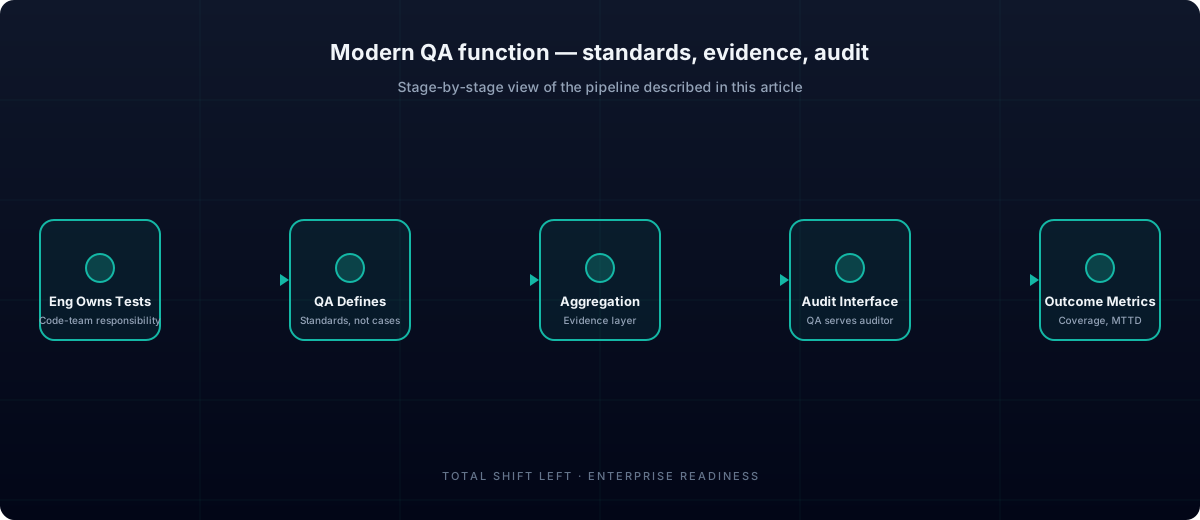
Modern QA function operating model — standards, evidence, audit.
Why this matters at enterprise scale
Forrester's 2024 State of QA report found that organizations repositioning the QA function around standards and audit support (rather than test execution) report 40% lower QA-related audit findings and 30% faster release cycles than organizations holding to traditional centralized-execution models. The repositioning is not optional — it's the difference between a QA function that scales and one that stalls.
Tools landscape
A practical view of the tool categories that scale across enterprise testing programs in this area:
| Category | Example tools |
|---|---|
| Source-controlled tests | GitHub, GitLab, Bitbucket with branch protection |
| Evidence aggregation | Internal services, Backstage plugins, custom dashboards over object storage |
| Coverage tracking | Total Shift Left coverage dashboards, Codecov for code-side tie-in |
| Quality gates | CI/CD plugins with documented thresholds and approval workflows |
| Audit interface | Thin services over the aggregation; queryable by date / API / control |
Tool selection is secondary to architecture. The patterns above hold regardless of which specific vendor you adopt.
Real implementation example
A representative deployment pattern from an enterprise rollout in this area:
Problem. A global insurance carrier had a 200-person centralized QA function executing tests against 600+ APIs. Velocity was bottlenecked. Audit cycles consumed 4 FTE-quarters. Engineering teams routinely shipped without QA approval to meet deadlines.
Solution. The QA function repositioned over 18 months: tests moved to engineering ownership, QA shifted to standards / audit / complex-flow testing. A 30-person QA team replaced the 200-person model. Evidence aggregation gave QA leadership visibility across all teams.
Results. Release velocity increased 2.5x. Audit support time dropped to 6 weeks per cycle (from 4 FTE-quarters). Production regression escape rate was unchanged. The repositioning succeeded because it was phased — engineers were trained on the standards and the golden path before ownership transferred.
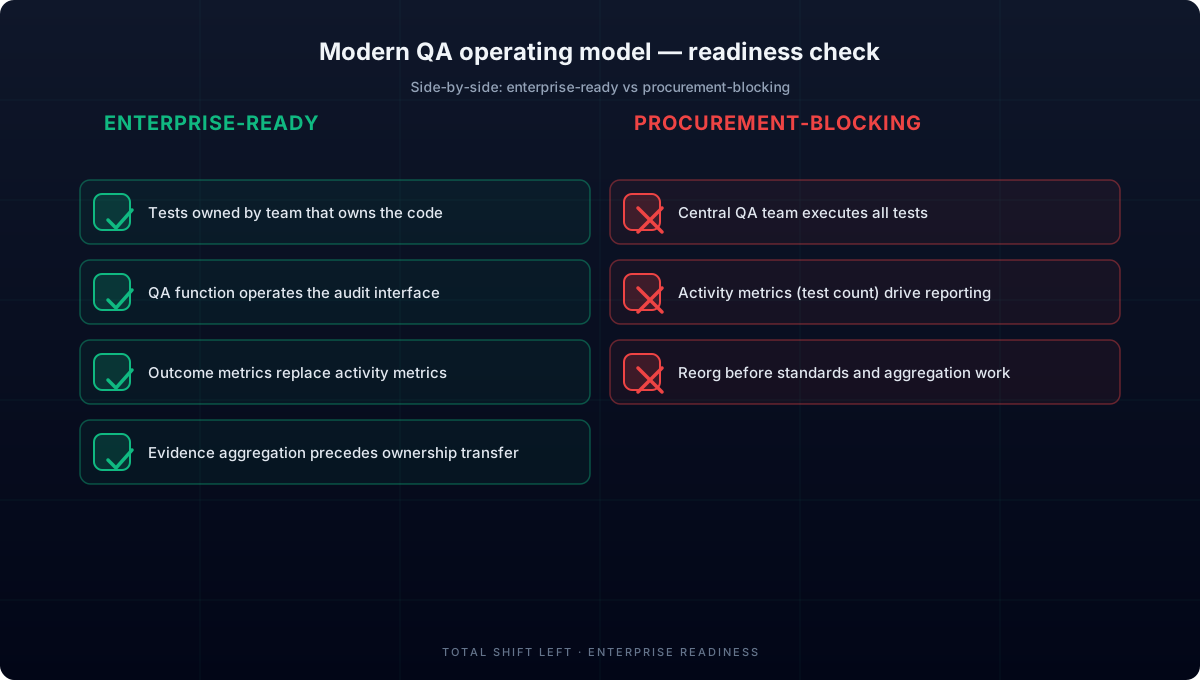
Enterprise test management — readiness checklist.
Reference architecture
A modern QA function operating model has four organizational components. Engineering teams own test execution for the code they own — unit, integration, API, and contract tests live with the code in source control, run in the team's CI, and flow evidence to the central aggregation. The QA function owns standards (coverage minimums, evidence formats, gating policies), the audit interface, and complex-flow / exploratory testing that doesn't automate cleanly. The platform engineering team operates the test platform, the evidence aggregation, and the CI/CD plugins. Security owns security-test policy and reviews; SRE owns chaos and resilience testing. The four functions connect via a central evidence aggregation that gives QA leadership cross-team visibility without requiring them to be the test owners. The pattern works because it separates governance from implementation — exactly the failure mode of traditional centralized-execution QA.
Metrics that matter
Four outcome metrics replace activity metrics in the modern model. API coverage against the floor — percentage of in-scope APIs meeting the standard — is the headline metric for engineering leadership; legible at a glance. Test pass rate trend — measured weekly across the aggregation — surfaces sudden drops as early warning signs. Mean time to detect regressions — from "regression introduced" to "regression caught by a test" — is the leading indicator of test suite health. Audit evidence completeness per release — percentage of releases with complete evidence — is the audit-facing metric. Activity metrics — test count, author count, execution count — are not on this list deliberately; they tell you the function is busy without telling you whether quality is improving.
Rollout playbook
A modern QA function transition takes 18-24 months done well. Year 0: standards in flight. Define standards. Build aggregation. Pilot federation with two willing engineering teams. Year 1: golden-path adoption. Ship the golden path. Onboard new APIs to the standard from day one. Use audit cycles as a forcing function for laggards. Year 2: reorganize. Shift QA staff doing test execution into specialty roles — audit support, complex-flow testing, governance. The function shrinks but doesn't disappear. Most retain or transition; loss to attrition is normal but manageable. Year 3: steady state. Small, senior QA function focused on strategy and audit. Engineering owns most testing. Coverage steadily climbing. Audits land cleanly. The biggest risk is reorganizing before the standards and aggregation work — the function loses leverage and the standards never establish.
Common challenges and how to address them
QA staff feel demoted by ownership transfer. Reframe as repositioning to higher-value work: strategy, governance, audit support, complex-flow testing. Provide training and career paths into the new roles.
Engineers don't want to write tests. Make the golden path fast: AI-generated tests from specs, one-click coverage, integrated CI/CD. Test-writing should take minutes, not hours.
Audit visibility breaks during transition. Stand up the evidence aggregation before transferring ownership. Visibility is the precondition, not the consequence.
Outsourced testing contracts assume execution-heavy model. Renegotiate during natural renewal cycles. Move outsourced QA up the value chain to audit support, complex-flow testing, exploratory testing.
Best practices
- Engineering owns test execution for the code they own
- QA function owns standards, audit interface, and complex-flow testing
- Evidence aggregation is the precondition for repositioning, not the consequence
- Phase the transition over 12-24 months; respect institutional knowledge
- Measure outcome metrics (escape rate, audit findings) not activity metrics (test count)
- Provide training and career paths for QA staff into the new roles
- Move outsourced QA up the value chain — strategy, audit, exploratory — not down
Implementation checklist
A pre-flight checklist enterprise teams can run against their current state:
- ✔ Tests are owned by the team that owns the code under test
- ✔ QA function defines standards, not test cases
- ✔ Evidence aggregation is operational before ownership transfer begins
- ✔ Audit interface can serve auditor queries without engineer involvement
- ✔ A documented training plan moves QA staff into new roles
- ✔ Outcome metrics replace activity metrics in QA reporting
- ✔ Outsourced QA contracts are repositioned during renewal cycles
- ✔ Engineering owns test execution; QA function owns the audit relationship
Conclusion
Enterprise test management in 2026 is a governance and operating-model problem. The leaders who get it right reposition the QA function around standards, evidence, and audit — and let engineering own test execution. The ones who hold to centralized execution end up with shadow tooling, paper compliance, and an audit cycle that consumes everyone's time without producing the evidence the audit actually wants.
FAQ
What's wrong with most enterprise test management tools?
Most are designed around manual test case management — Jira-style ticket trees of test steps owned by a central QA team. They don't fit modern engineering practice where tests live in source control beside the code, run in CI/CD, and produce evidence automatically. The right "test management" today is an evidence-aggregation layer, not a test-step database.
Should the QA function still own tests centrally?
No. Tests are owned by the team that owns the code under test — backend, platform, security where it applies. The QA function's role shifts to defining standards, operating the evidence aggregation, and being the audit interface. This is the model most modern enterprises converge on by 2026.
What metrics actually demonstrate test health at enterprise scale?
Coverage of in-scope APIs against the standard floor, test pass rate trend, mean time to detect regressions, and audit evidence completeness per release. Not test count, not author count, not execution count. Those are activity metrics; they don't tell leadership whether quality is improving.
How does this affect outsourced testing?
It moves outsourced QA up the value chain — away from manual test execution and toward strategy, audit support, and bespoke testing of complex flows that don't automate cleanly. Pure test-execution outsourcing is steadily disappearing as automation reaches regulated workloads.
Ready to shift left with your API testing?
Try our no-code API test automation platform free.