Shift Left Testing Checklist: 50-Point Audit for 2026
Shift left testing is easy to claim and hard to verify. Every team says they "test early"; few can prove it. This 50-point checklist is a practical audit — not a slide deck. Walk through it with your team, tick what you actually have, and the result is your real shift-left score for 2026.
In this guide
- Why a checklist?
- How to score yourself
- Category 1 — Spec hygiene (10 items)
- Category 2 — Automated tests (10 items)
- Category 3 — Contract gates (8 items)
- Category 4 — Security in CI (8 items)
- Category 5 — Performance smoke (7 items)
- Category 6 — Observability (7 items)
- What your score means
- FAQ
Why a checklist?
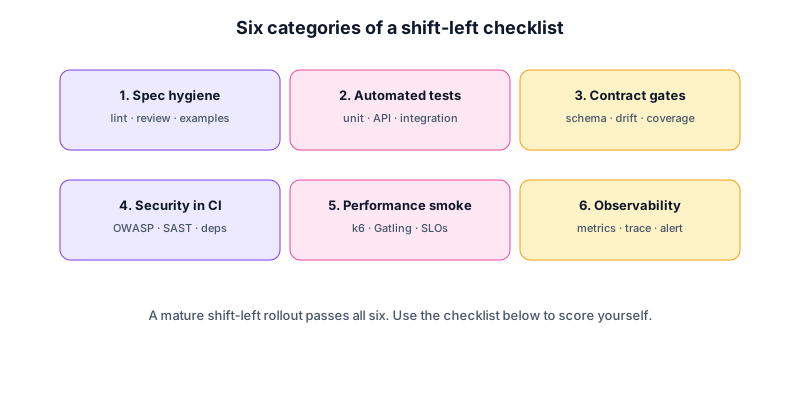
Shift left is a strategy, not a feature. The strategy succeeds when the right practices stack up: spec hygiene, automated tests, contract gates, security, performance smoke, observability. Each category compounds the others. A team strong in tests but weak in spec hygiene catches regressions but ships ambiguous APIs. A team strong in security scans but weak in contract gates blocks SQL injection but lets schema drift through.
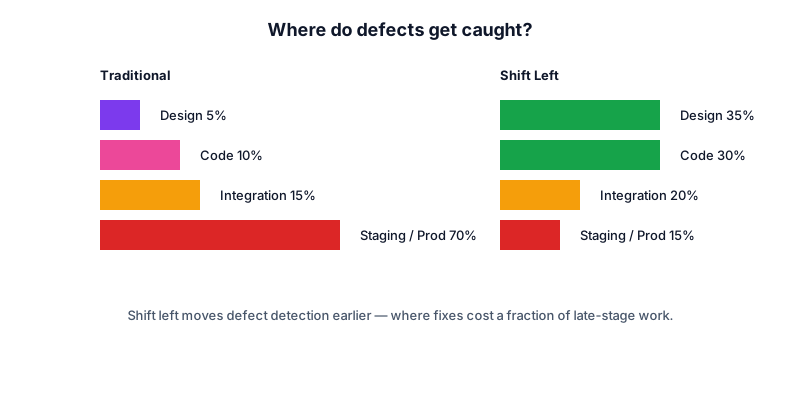
The data is consistent across organizations: traditional pipelines catch ~70% of defects in staging or production. Mature shift-left pipelines flip the curve — 65%+ in design and code, before integration. The checklist below operationalizes that flip.
How to score yourself
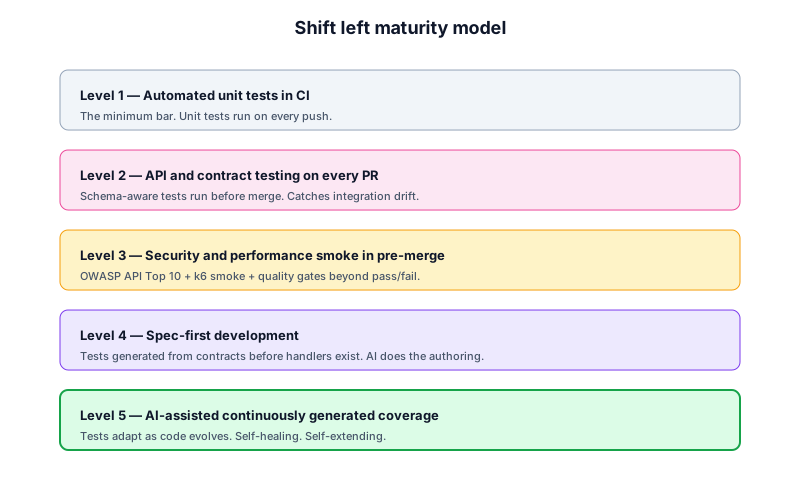
Each item is a simple yes/no. Tick what your team genuinely has — not what is on a roadmap. Then map your total to the maturity diagram below.
| Score | Maturity level |
|---|---|
| 0–15 | Level 1 — Automated unit tests in CI |
| 16–25 | Level 2 — API/contract testing on every PR |
| 26–35 | Level 3 — Security and performance smoke pre-merge |
| 36–45 | Level 4 — Spec-first development |
| 46–50 | Level 5 — AI-assisted continuously generated coverage |
Most teams in 2026 score between 18 and 28. Getting to 35 unlocks the largest defect-cost reductions.
Category 1 — Spec hygiene (10 items)
The OpenAPI (or AsyncAPI / GraphQL SDL) spec is the foundation. Every other category depends on it being authoritative and lint-clean.
- ☐ Every public API has an OpenAPI 3.x spec checked into the repo
- ☐ Spec is the source of truth — handlers are generated from or validated against it
- ☐ Spec is linted (Spectral, Redocly) on every commit
- ☐ Lint failures block the merge
- ☐ Every operation has a
summaryanddescription - ☐ Every parameter has constraints (min/max/enum/pattern)
- ☐ Every response has at least one
example - ☐ Security schemes are declared at the operation level, not just globally
- ☐ Errors use a standard envelope (RFC 7807 or equivalent)
- ☐ Spec PRs are reviewed by both producer and consumer teams
Ready to shift left with your API testing?
Try our no-code API test automation platform free. Generate tests from OpenAPI, run in CI/CD, and scale quality.
Category 2 — Automated tests (10 items)
Coverage is necessary but not sufficient. Coverage with no contract validation is theater.
- ☐ Unit tests run on every push, < 2 minutes for the typical PR
- ☐ Integration tests run on every PR, < 10 minutes
- ☐ Tests are generated from the OpenAPI spec, not hand-authored
- ☐ Negative tests (4xx) are at least 30% of the suite
- ☐ Authentication and authorization tests cover every protected endpoint
- ☐ Pagination, sorting, and filtering have explicit tests at boundaries
- ☐ Concurrency / idempotency tests exist for non-safe operations
- ☐ Tests run in parallel; the wall-clock CI budget stays under 10 minutes
- ☐ Flaky tests are tracked and fixed within one sprint
- ☐ Coverage is reported per endpoint, method, status code, and parameter — not just lines
Category 3 — Contract gates (8 items)
Contract gates are what convert "tests" into "shift left." They block merges on drift.
- ☐ Every response is asserted against the OpenAPI schema
- ☐ Drift fails the build (PR cannot merge)
- ☐ Coverage drop > 2% fails the build
- ☐ Pact (or equivalent) consumer-driven contracts run on every PR
- ☐ Producer changes notify consumer teams automatically
- ☐ Mock servers serve every external dependency in CI
- ☐ Mocks are generated from the same spec as production
- ☐ Contract proofs from CI are retained as audit evidence
For a deeper dive, see the shift left API testing guide.
Category 4 — Security in CI (8 items)
Security in CI is non-negotiable in 2026. Regulatory expectations (PCI-DSS 4.0, NIST SP 800-53, OWASP API Top 10) require it.
- ☐ SAST runs on every push (Snyk, Semgrep, SonarQube)
- ☐ Dependency scanning runs on every push
- ☐ OWASP API Top 10 checks run pre-merge
- ☐ Secret scanning runs pre-commit (gitleaks, trufflehog)
- ☐ Authentication tests cover token expiration, replay, algorithm swap
- ☐ Authorization tests cover BOLA (broken object level auth)
- ☐ Rate-limit responses are asserted (
429,Retry-After) - ☐ Security findings block release, not just notify
Category 5 — Performance smoke (7 items)
Performance smoke catches the regressions a load test in staging would catch a week too late.
- ☐ A k6 / Gatling smoke test runs on every PR for changed endpoints
- ☐ p95 latency regression > 20% blocks the merge
- ☐ Throughput regression > 10% blocks the merge
- ☐ Soak tests run nightly with leak alerts
- ☐ Load tests have explicit SLO assertions, not just "looks ok"
- ☐ Performance budgets are tracked release-over-release
- ☐ Caching, compression, and HTTP/2 are validated, not assumed
Category 6 — Observability (7 items)
Observability closes the loop. Without it, shift-left is blind to its own results.
- ☐ Defect-detection-stage is tracked release-over-release
- ☐ Time-to-first-byte is logged on every request
- ☐ Trace IDs propagate from CI through prod (OpenTelemetry)
- ☐ Errors are categorized (4xx vs 5xx) and trended
- ☐ Quality gate fail rate is dashboarded
- ☐ Mean time to feedback in CI is dashboarded
- ☐ Production incidents are post-mortem'd against the relevant CI gate (did the gate exist; if so, why didn't it catch this?)
What your score means
0–15 (Level 1). You have a CI pipeline. Most teams in this band have unit tests but no API contract validation. Highest-ROI next step: introduce spec linting and AI-generated functional coverage. Realistic time to Level 2: one quarter.
16–25 (Level 2). API testing happens on every PR. Most teams hand-author tests; that limits how far the suite scales. Highest-ROI next step: spec-driven generation and contract gates. Realistic time to Level 3: one quarter.
26–35 (Level 3). Security and performance smoke run pre-merge. The team is moving fast. Highest-ROI next step: spec-first development, where tests are generated before handlers exist. Realistic time to Level 4: two quarters.
36–45 (Level 4). Spec-first development is in place. The bottleneck is now hand-authored test maintenance for niche cases. Highest-ROI next step: AI-assisted continuous generation. Realistic time to Level 5: two quarters.
46–50 (Level 5). Top decile. The maintenance burden is near zero; the suite extends itself as the spec evolves. Focus on consumer-driven contracts and chaos engineering for resilience.
Real implementation example
A regulated insurer started this audit at 22/50 (Level 2). Six months later: 41/50 (Level 4). The compounding effect:
- 47% reduction in defect-fix cost
- 62% reduction in engineer time on test authoring
- 70% reduction in compliance audit prep time
- $700K+ first-year savings against platform investment
Tools used: Total Shift Left for spec-driven AI generation and contract gates, Spectral for lint, k6 for performance smoke, OpenTelemetry for trace propagation. The spec became the source of truth on day one of the rollout.
FAQ
What is a shift left testing checklist? A practical audit of the practices a team needs to validate that testing is actually happening early in the SDLC — not just claimed to be.
How do I score my team's maturity? Tick the items your team genuinely has. 0–15 is Level 1, 16–25 Level 2, 26–35 Level 3, 36–45 Level 4, 46–50 Level 5.
What is the single most important item? OpenAPI spec linting on every commit. The spec is the foundation of every other shift-left practice.
How long does it take to complete the checklist? ~90 days for a 30–80 engineer organization to reach Level 3 (35/50). Levels 4 and 5 take an additional 1–2 quarters each.
Does the checklist apply to Postman-only teams? Most items apply, but contract gates, AI generation, and self-hosted LLM coverage are weak in a Postman-only stack. Teams migrate to a spec-driven platform like Total Shift Left to score above 30.
Where do I start if my score is low? Spec linting and AI-generated functional coverage. Two changes that lift the next 10 items on the checklist.
Conclusion
Shift left is verified by what your team actually does, not what your slide deck says. Run the audit, get a real score, and use the result as the next-quarter roadmap. The largest gains live between scores of 25 and 35 — the band where contract gates, security in CI, and AI generation compound.
Ready to lift your score by 10 points in a quarter? Import an OpenAPI spec into Total Shift Left and watch contract gates land on day one. Related: Shift Left API Testing pillar guide · What is Shift Left Testing? · API testing in CI/CD.
Ready to shift left with your API testing?
Try our no-code API test automation platform free.