
Standardizing API Testing Across Enterprise Teams: A Platform Engineering Playbook (2026)
How platform-engineering teams roll out a single API testing standard across dozens of product teams without forcing a common toolchain. Federation, golden paths, evidence formats, and the trade-offs that actually matter.
What is this
Standardizing API testing across enterprise teams is the platform-engineering practice of rolling out a single API testing program across dozens of product teams without forcing every team onto the same tool. The pattern that scales — the federation pattern — separates governance (standards, evidence formats, gating policies owned by the platform team) from implementation (tools and authoring style owned by product teams). The unifying principle is to standardize outputs, not tools.
Key components
Each enterprise program in this area has the same load-bearing components, regardless of vendor. The components separate cleanly into governance, enforcement, and evidence layers.
Common evidence format
Every team's pipeline produces test results in a common format (JUnit XML is the lowest common denominator). The format is what the central aggregation reads. Adapters convert non-standard outputs (Postman runs, Newman, custom JSON) so teams aren't forced to rewrite suites.
Coverage definition floor
A common minimum: every in-scope API has a test for every endpoint × method × success status code. Teams can exceed it; they cannot fall below. The floor is enforced as a CI quality gate.
Gating policy
A common minimum on what blocks a release — high-severity security finding, unintentional contract-breaking change, coverage below the floor. Teams can add stricter gates; they cannot have weaker ones.
Golden-path repo template
The platform team's opinionated default — a repository template with the recommended tool, evidence emission, and CI/CD wiring pre-configured. Most teams adopt the golden path because it's faster than building their own.
Central aggregation
A write-only ingestion service over scalable object storage. Read patterns hit indexed views (OpenSearch, Elastic) for governance dashboards and audit queries. The aggregation is the platform team's actual product.
Audit interface
A thin service over the aggregation that auditors query directly — by date, by API, by control. Without it, audit cycles consume engineering time at every iteration; with it, the QA function serves the auditor without engineer involvement.
Table of Contents
- Why mandating one tool fails at enterprise scale
- The federation pattern
- What to actually standardize
- Building the golden path
- Evidence aggregation across teams
Why mandating one tool fails
The historical pattern at most enterprises is the testing center of excellence picking a tool, mandating it across all product teams, and watching adoption stall at 30-40%. The reasons repeat across organizations:
- Tool fit varies by API surface. A team building a customer-facing GraphQL API needs different ergonomics than a team integrating SOAP/WSDL with legacy core banking middleware.
- Existing investments resist replacement. A team with three years of mature Postman collections won't migrate to a different tool just because the platform team prefers it.
- Procurement timelines lag adoption. By the time a tool gets enterprise-wide procurement clearance, two of the largest product teams have built around something else.
The teams that try to enforce a single tool usually end up with two outcomes: shadow tooling (teams use what they want and the platform team doesn't know), or a paper standard (everyone says they comply, evidence proves otherwise).
A more durable pattern is to standardize the outputs and let teams choose tools that produce them.
The federation pattern
The federation pattern works because it separates governance from implementation:
- Governance sits with the platform team: define what evidence is required, what coverage minimum is acceptable, what gates a release. Encoded as policy.
- Implementation sits with product teams: choose a tool, integrate it into the team's CI/CD, produce the required evidence. Bounded by the policy.
This means the platform team doesn't have to be the world's expert on every API testing tool — they need to be the expert on what good API testing looks like and what evidence demonstrates it. Giving each product team its own isolated workspace lets the platform team federate ownership cleanly: teams manage their own suites and environments while the standard evidence rolls up centrally.
The trade-off: federation produces a heterogeneous tool landscape that's harder to debug and harder to optimize centrally. The platform team has to be comfortable with that trade-off in exchange for actually achieving enterprise-wide coverage.
What to actually standardize
Three artifacts scale across heterogeneous tool choices:
Evidence format. Every team's pipeline produces test results in a common format (JUnit XML is the lowest common denominator; OpenAPI conformance reports work for spec-driven testing). The format is what the platform team's aggregation reads.
Coverage definition. A common minimum: every in-scope API has a test for every endpoint × method × success status code combination. Teams can exceed this — coverage of error paths, schema validation, contract drift, security scenarios — but the floor is uniform.
Ready to shift left with your API testing?
Try our no-code API test automation platform free. Generate tests from OpenAPI, run in CI/CD, and scale quality.
Gating policy. What blocks a release? Common minimums: any high-severity security finding, any contract-breaking change without explicit approval, coverage below the floor. Teams can add stricter gates; they cannot have weaker ones.
Anything more specific than these — UI ergonomics, test authoring style, AI features — is team choice.
Building the golden path
The golden path is the platform team's actual product. It's the one-command opinionated setup that gives a new product team a working API testing pipeline producing standard evidence within a day.
A typical golden path includes:
- A repository template with the test framework, CI configuration, and evidence-emission already wired
- A documented guide for importing OpenAPI / Swagger / WSDL specs and generating an initial test suite
- Pre-configured CI quality gates aligned to the gating policy
- Pre-configured evidence emission to the central aggregation
- A getting-started SLA: time from "team decides" to "team has tests running" in under one day
Most teams adopt the golden path because it's faster than building their own. The teams that don't are usually the ones with mature investments in something else; federate those, don't fight them.
For deeper coverage of test framework patterns, see how to build a test automation framework. For governance / center of excellence structure, see building a testing center of excellence.
Evidence aggregation across teams
The aggregation layer is where the platform team's investment pays off. Three capabilities matter:
Coverage rollup. Per-team and per-API coverage metrics rolled up into a single dashboard. Used by engineering leadership to see where the gaps are without needing to ask each team.
Audit-ready evidence retention. Test execution evidence retained centrally for the audit window — typically per-release run reports stored with the release record, queryable by date and API name.
Gating policy enforcement. The aggregation knows whether a given release passed the common gating policy. Engineering leadership can see at a glance which releases shipped despite policy violations.
The aggregation is usually a thin service over object storage with a search index. The complex part isn't building it — it's establishing the convention that every team's pipeline emits to it.
For complementary content on coverage measurement, see how to measure API test coverage and API quality gates: what to measure.
Standardizing API testing across enterprise teams is mostly a governance and product-management problem, not a tool selection problem. The platform engineering teams that get it right ship a federation pattern: standard outputs, opinionated golden path, central aggregation. The teams that try to enforce a single tool end up with shadow tooling and paper compliance.
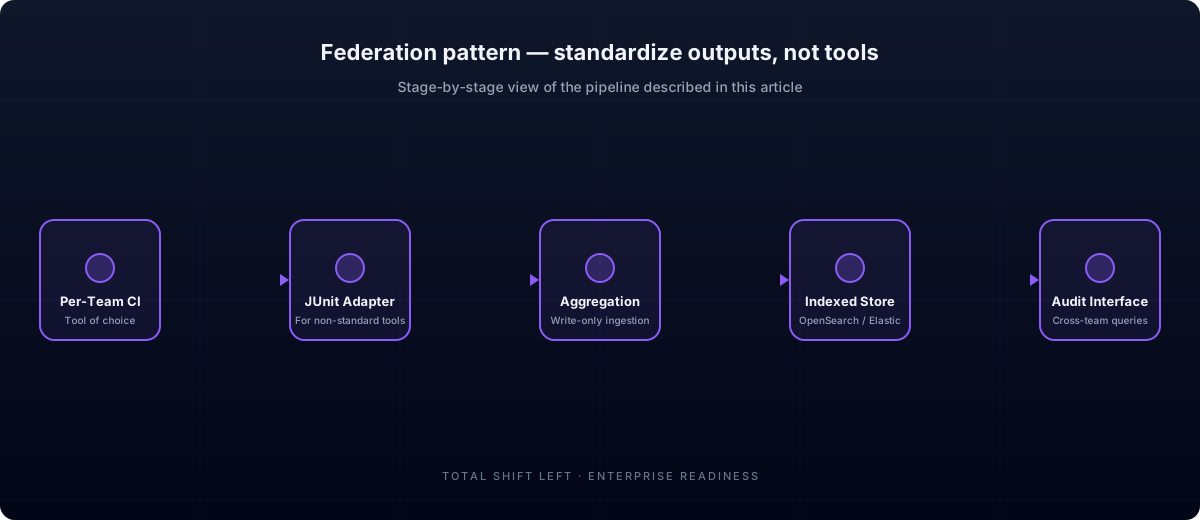
Federation pattern — standardize outputs, not tools.
Why this matters at enterprise scale
McKinsey's 2025 platform-engineering benchmark found that organizations standardizing testing outputs (rather than tools) across 50+ engineering teams reduced average release-cycle time by 24% versus tool-mandated organizations. The data is clear: the standardization that matters at enterprise scale is on evidence formats and gating policies, not on which UI authors the tests.
Tools landscape
A practical view of the tool categories that scale across enterprise testing programs in this area:
| Category | Example tools |
|---|---|
| Common evidence format | JUnit XML (lowest common denominator), OpenAPI conformance reports |
| Coverage measurement | Total Shift Left, Pact (contract), Schemathesis (property-based) |
| CI/CD policy enforcement | Open Policy Agent, GitHub branch protection rules, GitLab approval rules |
| Evidence aggregation | Internal services over object storage with search index (OpenSearch, Elastic) |
| Golden-path repository templates | GitHub template repos, Backstage software templates, internal scaffolds |
Tool selection is secondary to architecture. The patterns above hold regardless of which specific vendor you adopt.
Real implementation example
A representative deployment pattern from an enterprise rollout in this area:
Problem. A Fortune 500 financial services org with 40+ product teams had three years of fragmented API testing — some teams used Postman, some ReadyAPI, some Karate, some hand-rolled. Coverage was unknown across teams. Audit support consumed 3 FTE-quarters per cycle.
Solution. The platform team adopted a federation pattern: standardized JUnit evidence format, mandatory coverage floor (endpoint × method × success status), central aggregation layer reading evidence from every team's pipeline. A golden-path repo template made the right pattern the easy pattern.
Results. Within 18 months, 35 of 42 teams produced standard evidence. Audit support time dropped to 2 weeks per cycle. Tool diversity dropped naturally as teams adopted the golden path; the platform team didn't mandate a single tool but ~60% of teams converged on the recommended one.
Free 1-page checklist
API Testing Checklist for CI/CD Pipelines
A printable 25-point checklist covering authentication, error scenarios, contract validation, performance thresholds, and more.
Download Free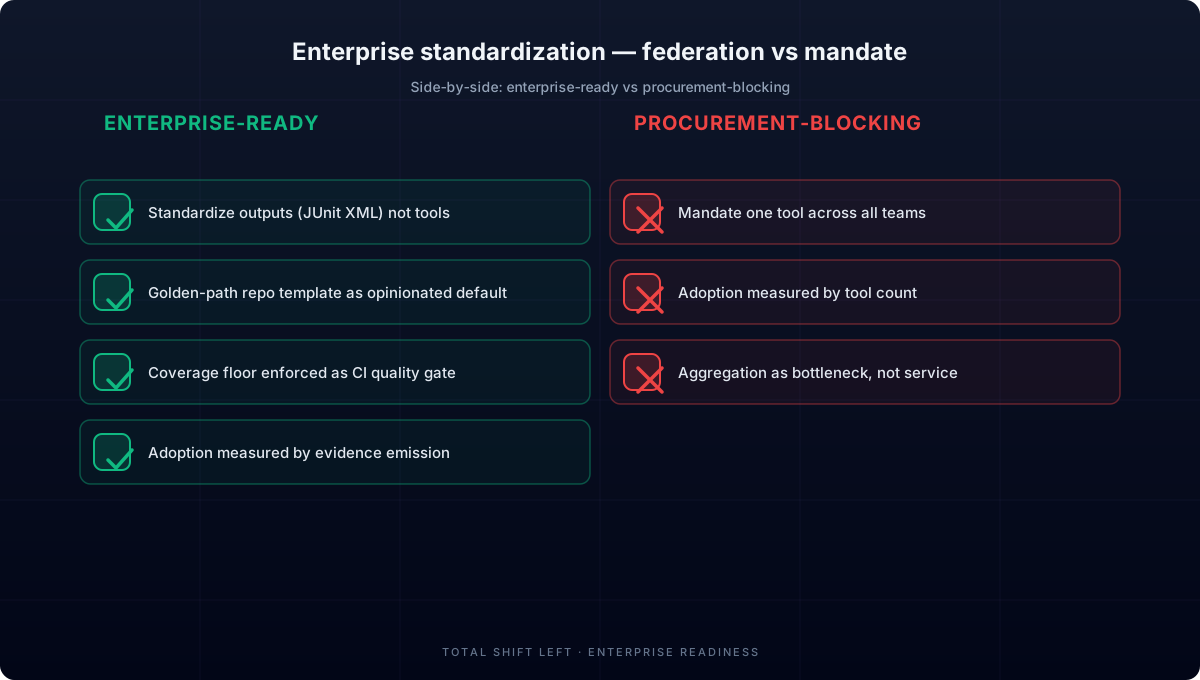
Enterprise standardization — readiness checklist.
Reference architecture
A federation-pattern architecture has three layers. Per-team test infrastructure — each product team picks tools that produce JUnit XML or equivalent standard evidence; the platform team doesn't prescribe. Adapter layer — for teams whose tools don't emit standard evidence natively, lightweight adapters convert (Postman runs to JUnit, Newman output to JUnit, custom JSON to JUnit). Central aggregation — a write-only ingestion service over scalable object storage, with read patterns hitting indexed views (OpenSearch, Elastic) for governance dashboards and audit queries. Golden-path repo template — the platform team's opinionated default with the recommended tool, evidence emission, and CI/CD wiring pre-configured. Coverage and quality-gate enforcement — encoded as policy via Open Policy Agent or equivalent, applied at CI level. The architecture deliberately separates governance (platform team owns) from implementation (product teams own).
Metrics that matter
Four metrics establish federation health. Evidence emission coverage — percentage of in-scope APIs whose pipeline produces standard evidence — is the headline metric; 90%+ is the floor for a credible program. Golden-path adoption rate — percentage of new APIs onboarded onto the recommended tool — measures whether the golden path is genuinely the easy path. Audit query response time — minutes from auditor request to evidence delivery — measures the aggregation layer's effectiveness; mature programs deliver in minutes versus days for hand-assembled evidence. Tool diversity — count of distinct test tools producing evidence — is a leading indicator; trending downward over time as teams converge on the golden path. Report on a quarterly cadence to engineering and compliance leadership.
Rollout playbook
Federation rollout typically takes 18-24 months at enterprise scale. Months 1-3: foundation. Define the evidence format. Build the central aggregation. Sign off on coverage minimums and gating policy. Months 4-6: golden path. Ship the opinionated repo template with the recommended tool. Onboard 2-3 willing pilot teams. Iterate on documentation. Months 7-12: rollout. Open onboarding to all teams. Provide adapters for teams with existing investments. Phase coverage-floor enforcement gradually. Months 13-24: governance. Add audit interface. Establish quarterly review cadence with engineering leadership. Tune policies based on observed program performance. Most enterprises reach 60% evidence emission by month 12 and 90%+ by month 24; the timeline is governance and change-management rather than technical.
Common challenges and how to address them
Teams resist a perceived mandate. Reframe as standardizing outputs, not tools. Teams keep their tool of choice as long as it produces the standard evidence. Most resistance evaporates when the mandate isn't about replacing their tool.
Existing evidence is in incompatible formats. Provide adapters that convert common formats (Postman runs, Newman output, custom JSON) to JUnit. Don't force teams to rewrite suites.
Aggregation layer becomes a bottleneck. Build it as a write-only ingestion service over scalable object storage. Read patterns (governance dashboards, audit queries) hit indexed views, not the storage directly.
Coverage floor is too aggressive for legacy teams. Phase in over 12-18 months. Start with new APIs only; let mature APIs catch up over time. Measure progress, not perfection.
Best practices
- Standardize outputs (evidence formats, coverage minimums, gating policies), not tools
- Provide a golden-path repo template as the easy default for new APIs
- Build evidence aggregation as a separate service from any test platform
- Phase in coverage floors gradually; don't shock legacy teams
- Measure adoption by evidence emission, not by tool count
- Federate ownership: platform team owns standards, product teams own implementation
- Surface the standard's value (audit time saved, regression escape rate) regularly
Implementation checklist
A pre-flight checklist enterprise teams can run against their current state:
- ✔ Common evidence format (JUnit XML or equivalent) is mandatory across all teams
- ✔ A coverage floor is documented and enforced via CI/CD quality gates
- ✔ A central aggregation layer pulls evidence from every team's pipeline
- ✔ A golden-path repo template makes the right pattern the easy pattern
- ✔ Adoption is measured by evidence emission, not by tool selection
- ✔ Audit queries can be served from the aggregation without engineer involvement
- ✔ Phased rollout plan respects legacy teams' existing investments
- ✔ Platform team owns standards; product teams own implementation
Take the next step. See how enterprise governance for API testing applies these ideas to your workflow, or explore security and compliance for the broader picture.
Conclusion
Standardizing API testing across enterprise teams is a governance and product-management problem disguised as a tools problem. The platform engineering teams that get it right ship a federation pattern: standard outputs, opinionated golden path, central aggregation. The teams that try to enforce a single tool end up with shadow tooling and paper compliance — both of which fail the audit they were supposed to satisfy.
FAQ
Should we mandate one API testing tool across the enterprise?
Usually not. Mandating tools at scale rarely sticks — teams find workarounds and the standard decays. Mandate the outputs (test evidence formats, coverage reporting, security scan results) and let teams choose tools that produce those outputs. Provide one recommended golden-path tool for teams that don't want to choose.
What's the right "standard" to enforce?
Three things scale across teams: a common evidence format (JUnit / OpenAPI conformance reports), a common coverage definition (endpoint × method × status code minimum), and a common gating policy (what blocks a release). The tool that produces these is team choice.
How do you measure adoption?
By the percentage of in-scope APIs whose pipeline produces the common evidence format, not by the number of teams using a particular tool. A team using a different tool that produces the same evidence is fully compliant; a team using the recommended tool but not producing evidence is not.
What's the platform team's actual product?
The golden path: a one-command opinionated setup that gives a product team a working API testing pipeline producing standard evidence in under a day. Plus the evidence aggregation that rolls up results across teams for governance and audit.
Ready to shift left with your API testing?
Try our no-code API test automation platform free.