
Swagger to OpenAPI Migration Guide for Testing Teams (2026)
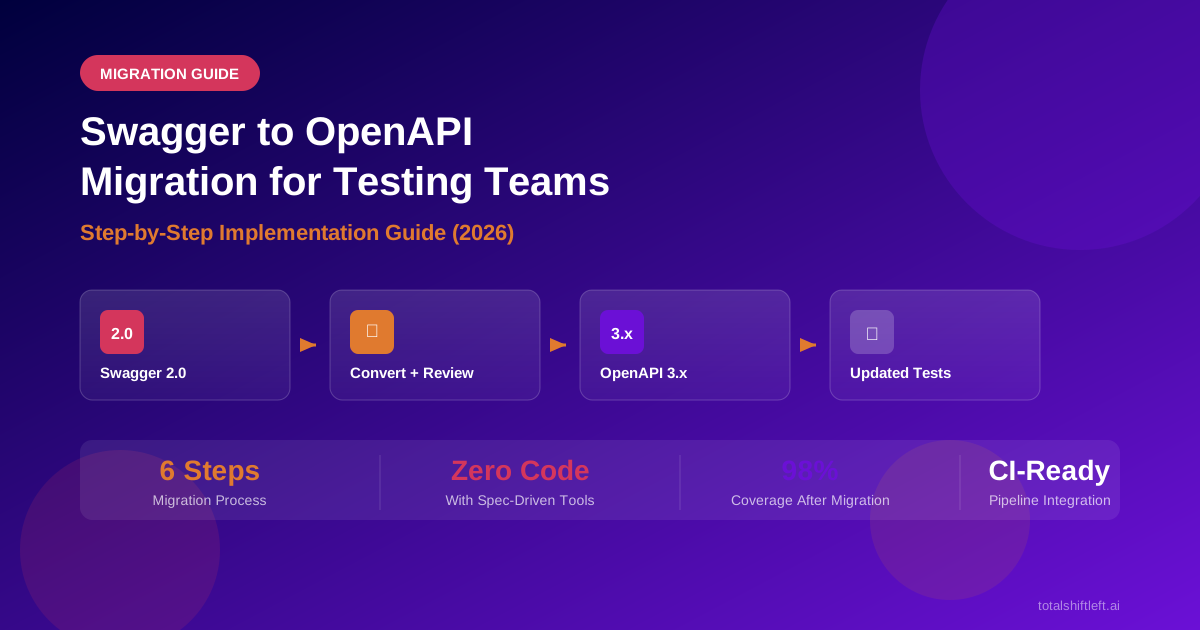
In this guide you will learn:
- What Swagger to OpenAPI migration means for testing teams
- Why testing teams should migrate now
- Key structural differences that affect tests
- The migration workflow from start to finish
- Tools for automated spec conversion
- How to update your test suite after migration
- Real-world migration example with results
- Common migration mistakes to avoid
- Best practices for a smooth migration
- Migration checklist
- Frequently asked questions
Introduction
Your API testing infrastructure is built on Swagger 2.0 specs. The test suite validates request parameters, response schemas, and authentication flows using the structures that Swagger defines -- host, basePath, definitions, produces, consumes. Everything works.
Then a new microservice ships with an OpenAPI 3.0 spec. The existing test framework does not understand requestBody, the servers array, or content media type mappings. The team writes a manual workaround. Another service migrates. Another workaround. Within months, the test infrastructure is a patchwork of version-specific handling that nobody wants to maintain.
This scenario is playing out across organizations that adopted Swagger early and now face an ecosystem that has moved to OpenAPI 3.x. The swagger to openapi migration testing challenge is not just about converting a spec file -- it is about updating test generation logic, validation rules, CI/CD pipeline configurations, and team workflows to work with the modern specification format.
This guide walks testing teams through the complete migration process: understanding what changed structurally, converting specs safely, updating test suites, adjusting CI/CD pipelines, and avoiding the mistakes that cause teams to spend weeks on what should take days. Whether you manage one API or fifty microservices, this guide provides a concrete path from Swagger 2.0 to OpenAPI 3.x without breaking your existing test coverage.
What Is Swagger to OpenAPI Migration?
Swagger to OpenAPI migration is the process of converting API specifications from the Swagger 2.0 format to OpenAPI 3.0 or 3.1, and updating all downstream tooling -- including test suites, CI/CD pipelines, code generators, and documentation systems -- to work with the new specification structure. For testing teams, this migration directly affects how tests are generated, how schemas are validated, and how API contracts are enforced.
Swagger 2.0 was the dominant API specification format from 2014 to 2017. In 2017, the specification was donated to the OpenAPI Initiative under the Linux Foundation and renamed to OpenAPI Specification (OAS). OpenAPI 3.0 was released as a significant restructuring of the format, and OpenAPI 3.1 (released 2021) brought full JSON Schema compatibility. For a detailed comparison of the 3.0 and 3.1 differences, see the OpenAPI 3.1 vs 3.0 guide.
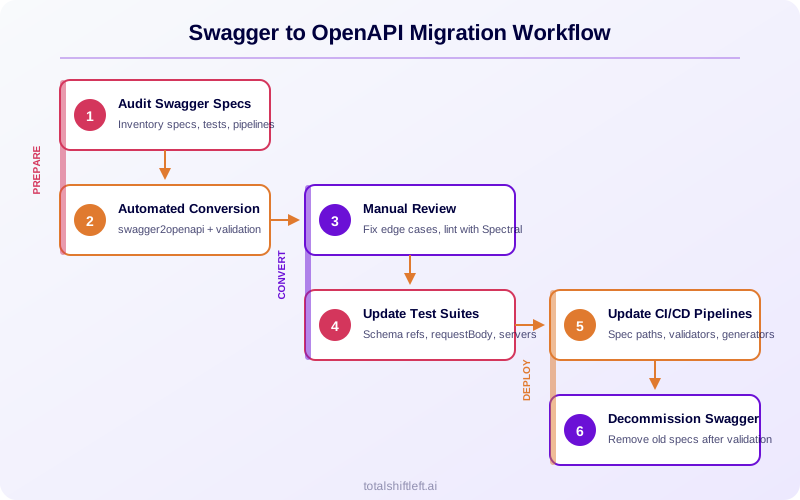
The migration is more than a file format conversion. While automated tools can translate the structural syntax from Swagger 2.0 to OpenAPI 3.0, testing teams must also address the semantic changes: how request bodies are defined, how authentication schemes are structured, how servers are specified, and how content types are associated with operations. Each of these changes affects test generation logic and validation rules.
Why Testing Teams Should Migrate to OpenAPI 3.x
Richer schema validation capabilities
OpenAPI 3.x supports oneOf, anyOf, allOf, and not composition keywords that enable precise schema definitions for polymorphic responses. Swagger 2.0's limited schema support forces testing teams to write custom validation logic for complex response structures. With OpenAPI 3.x, schema validation can handle discriminated unions, nullable fields, and conditional schemas natively, catching drift that Swagger-based validation misses entirely.
Modern tooling ecosystem
The API tooling ecosystem has moved to OpenAPI 3.x. Test generation platforms, mock servers, documentation generators, and SDK generators increasingly treat Swagger 2.0 as legacy. New features -- AI-driven test generation, property-based testing, automatic edge case detection -- are built for OpenAPI 3.x first and often never backported. Teams on Swagger 2.0 are locked out of these capabilities. Platforms like Total Shift Left generate comprehensive test suites from OpenAPI specs that leverage the richer schema definitions for better test coverage.
Better request body modeling
Swagger 2.0 models request bodies as special parameters with in: body, limiting each operation to a single body parameter. OpenAPI 3.x introduces a dedicated requestBody object with per-content-type schemas, enabling operations to accept JSON, XML, form data, and file uploads with distinct schemas for each. This directly improves test generation -- testing tools can automatically generate tests for each content type an endpoint accepts.
Improved security scheme definitions
OpenAPI 3.x restructured security definitions to support OAuth 2.0 flows, OpenID Connect, and bearer tokens with greater specificity. For testing teams that validate authentication and authorization, this means more precise test generation for security testing scenarios and better alignment with modern API security practices.
Full JSON Schema compatibility (3.1)
OpenAPI 3.1 aligns fully with JSON Schema 2020-12, removing the divergences that existed in 3.0 and Swagger 2.0. This means testing tools can use standard JSON Schema validators directly, reducing custom validation code and improving interoperability with schema validation libraries across languages.
Key Structural Differences Between Swagger 2.0 and OpenAPI 3.x
Understanding the structural differences is essential for updating your test suites. Each change below affects how tests reference, validate, or generate API interactions.
Request body definition
Swagger 2.0: Request bodies are defined as parameters with in: body. Only one body parameter is allowed per operation, and file uploads use in: formData.
OpenAPI 3.x: A dedicated requestBody object exists at the operation level. Each request body specifies content types with separate schemas, supporting multipart uploads, multiple content types, and encoding definitions.
Test impact: Tests that reference parameters[?(@.in=='body')] paths need restructuring to use requestBody.content['application/json'].schema. Tests that validate file uploads need to use the new multipart encoding format.
Server configuration
Swagger 2.0: API base URL is constructed from three separate fields: host, basePath, and schemes.
OpenAPI 3.x: A servers array provides complete URLs with variable substitution support, enabling multiple environments in a single spec.
Test impact: Test frameworks that construct base URLs from separate Swagger fields need updating to parse the servers array. Environment-specific test configurations benefit from server variables.
Content type handling
Swagger 2.0: Global produces and consumes arrays define accepted content types for the entire API, with optional per-operation overrides.
OpenAPI 3.x: Content types are defined per-operation within requestBody and responses objects using a content map.
Test impact: Tests that rely on global content type settings need restructuring to check content types at the operation level. Test generation logic must iterate over the content map for each response.
Schema references
Swagger 2.0: Reusable schemas are stored under definitions.
OpenAPI 3.x: Reusable components are organized under components/schemas, components/parameters, components/responses, components/requestBodies, and more.
Test impact: Any test tooling that resolves $ref pointers to #/definitions/ paths must be updated to resolve #/components/schemas/ and other component paths.
Security definitions
Swagger 2.0: Security schemes are defined under securityDefinitions with basic, apiKey, and oauth2 types.
OpenAPI 3.x: Security schemes are under components/securitySchemes with added support for http, openIdConnect, and bearer token formats.
Ready to shift left with your API testing?
Try our no-code API test automation platform free. Generate tests from OpenAPI, run in CI/CD, and scale quality.
Test impact: Tests that validate authentication headers or configure security for test execution need updating to use the new scheme structure.
Swagger to OpenAPI Migration Workflow
The migration follows six phases. Each phase has clear inputs, outputs, and validation criteria.
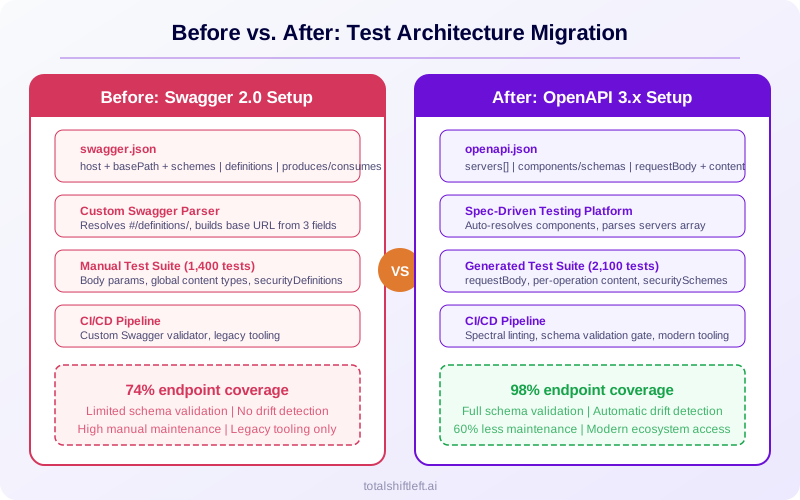
Step 1: Audit your current Swagger specs
Before converting anything, inventory every Swagger 2.0 spec your team maintains. Document which services each spec describes, which test suites depend on each spec, and which CI/CD pipelines reference them. Identify specs that use features with significant migration complexity: file uploads, polymorphic schemas using discriminators, multiple authentication types, and custom extensions (x- prefixed fields).
Output: A spreadsheet listing each spec, its dependent test suites, pipeline references, and complexity flags.
Step 2: Run automated conversion
Use swagger2openapi or the Swagger Editor to convert each spec from Swagger 2.0 to OpenAPI 3.0. Run the conversion tool with strict validation enabled to surface issues immediately:
npx swagger2openapi swagger.json -o openapi.json --patch --warnOnly
Review the conversion warnings. Common issues include: discriminator syntax changes, $ref paths that need updating, formData parameters that need restructuring into requestBody, and security scheme type changes.
Output: Converted OpenAPI 3.0 specs with a list of warnings to address manually.
Step 3: Manual spec review and correction
Automated conversion handles 80-90% of the migration, but edge cases require manual attention. Review each converted spec for: content type accuracy in requestBody definitions, servers array correctness (the tool converts host/basePath but may not include all environments), security scheme completeness, and nullable field handling (Swagger 2.0's x-nullable maps to OpenAPI 3.0's nullable keyword differently than expected).
Validate the corrected spec with a linter like Spectral to catch structural issues:
npx @stoplight/spectral lint openapi.json
Output: Validated OpenAPI 3.0 specs that accurately describe each API.
Step 4: Update test suites
This is the most labor-intensive step. Update your test framework and individual tests to work with OpenAPI 3.x structures:
- Schema reference paths: Update all
$refresolution from#/definitions/to#/components/schemas/ - Request body construction: Migrate from parameter-based body handling to
requestBodycontent-type mapping - Base URL construction: Replace
host/basePath/schemesparsing withserversarray parsing - Content type assertions: Move from global
produces/consumesto per-operation content type validation - Security configuration: Update authentication setup to use new security scheme structure
For teams using spec-driven testing platforms, this step is significantly simpler. Platforms like Total Shift Left that generate tests from the OpenAPI spec automatically adapt to the new structure -- import the converted spec, and the platform generates updated tests without manual test code changes.
Output: Updated test suites that execute against OpenAPI 3.x specs.
Step 5: Update CI/CD pipelines
Adjust pipeline configurations to reference the new OpenAPI 3.x spec files. Update spec validation steps to use OpenAPI 3.x-compatible validators. If your pipeline uses spec-based code generation (client SDKs, server stubs), update the generator configurations. Ensure pipeline environment variables that reference spec paths or API base URLs are updated.
For teams that automate testing in CI/CD, the CI/CD automation guide covers pipeline configuration patterns that work with OpenAPI 3.x.
Output: Pipeline configurations that build, test, and deploy using OpenAPI 3.x specs.
Step 6: Decommission Swagger 2.0 specs
After the parallel running period confirms that all tests pass against the OpenAPI 3.x specs and no pipeline relies on the old format, remove the Swagger 2.0 spec files from version control. Update documentation, onboarding guides, and any external references to point to the new specs.
Output: A single set of OpenAPI 3.x specs serving as the source of truth for all API testing.
Tools for Swagger to OpenAPI Conversion
| Tool | Type | Conversion Quality | Test Suite Support | CI/CD Integration | Cost |
|---|---|---|---|---|---|
| swagger2openapi | npm CLI | High -- handles most edge cases | No -- spec conversion only | CLI-friendly, scriptable | Free / Open source |
| Swagger Editor | Web / Desktop | Good -- visual diff review | No -- spec conversion only | Manual process | Free |
| SwaggerHub | SaaS platform | High -- enterprise features | Mock server generation | API versioning, webhooks | Paid |
| Stoplight Studio | Desktop / SaaS | Good -- visual editor | Mock server, linting | Git integration | Free tier available |
| Total Shift Left | Testing platform | Accepts both formats | Full test generation from spec | Azure DevOps, Jenkins, REST | Paid -- see pricing |
| APIMatic | SaaS | High -- SDK generation focus | SDK test generation | CI/CD transformer | Paid |
For most testing teams, the recommended approach is: use swagger2openapi for the conversion step, Spectral for validation, and a spec-driven testing platform for test generation. This separates the conversion concern from the testing concern, giving you control over each phase.
Teams evaluating their overall API testing tooling alongside the migration may find the Postman alternatives comparison useful for understanding how modern platforms handle spec-driven testing natively.
Updating Your Test Suite After Migration
Schema validation updates
The most common test failures after migration come from schema reference path changes. Every assertion that validates a response schema against a $ref pointer needs updating:
Before (Swagger 2.0):
$ref: '#/definitions/User'
After (OpenAPI 3.x):
$ref: '#/components/schemas/User'
Beyond path changes, OpenAPI 3.x schemas support composition keywords (oneOf, anyOf, allOf) that your validators must handle. If your test framework uses a JSON Schema validator, verify it supports the OpenAPI 3.0 dialect (or JSON Schema 2020-12 for OpenAPI 3.1).
Request body test restructuring
Tests that send request bodies need restructuring from the parameter model to the request body model. Instead of finding the body parameter in the parameters array, tests should read the requestBody object and iterate over its content map to determine valid content types and their corresponding schemas.
For endpoints that accept multiple content types, generate separate test cases for each content type -- this is a testing improvement that Swagger 2.0's structure made difficult.
Authentication test updates
Update test setup code that configures authentication. The security scheme structure change from securityDefinitions to components/securitySchemes affects how tests read scheme types, scopes, and flow configurations. Bearer token tests should use the new http scheme type with bearer format rather than the Swagger 2.0 apiKey workaround.
Response validation improvements
Take advantage of OpenAPI 3.x's per-operation content type definitions to improve response validation. Instead of validating against a global content type assumption, validate that each response's content type matches what the operation declares. This catches issues where an endpoint returns XML when the spec declares JSON, a class of bug that global produces arrays in Swagger 2.0 obscured.
Real Implementation Example
The problem
A financial services company maintained 23 microservices, all documented with Swagger 2.0 specs. Their testing infrastructure -- built over four years -- included 1,400+ API tests written against Swagger structures, custom schema validators that resolved #/definitions/ references, and CI/CD pipelines in Azure DevOps that ran spec validation as a quality gate. Three new services launched with OpenAPI 3.0 specs, forcing the team to maintain two parallel validation systems. Test maintenance overhead had increased by 40%, and the team was unable to use modern test generation tools that required OpenAPI 3.x input.
The solution
The team executed the migration in four weeks across three phases:
Phase 1 (Week 1): Conversion and audit. They converted all 23 Swagger 2.0 specs using swagger2openapi with the --patch flag. The conversion surfaced 34 warnings across the specs, primarily related to discriminator syntax, nullable field handling, and formData-to-requestBody conversions. Each warning was manually reviewed and resolved.
Phase 2 (Week 2-3): Test suite migration. Rather than manually updating 1,400 tests, they adopted a spec-driven testing platform that generates tests directly from OpenAPI specs. They imported the converted OpenAPI 3.0 specs and generated new test suites that covered every endpoint, method, and response code. The platform automatically handled requestBody structures, servers array parsing, and components/schemas references. Manual effort was limited to configuring environment-specific server variables and authentication credentials.
Phase 3 (Week 4): Pipeline update and decommission. They updated Azure DevOps pipeline configurations to reference OpenAPI 3.x specs, replaced the custom Swagger validator with Spectral-based linting, and ran parallel test execution against both old and new test suites for one week. After confirming zero regressions, they decommissioned the Swagger 2.0 specs and the old test suites.
The results
- Migration duration: 4 weeks for 23 microservices (original estimate was 12 weeks)
- Test count: Increased from 1,400 to 2,100 tests (platform generated edge cases the manual tests missed)
- Coverage: Endpoint coverage increased from 74% to 98%
- Schema validation failures caught in first month: 11 drift instances that the old Swagger-based tests would not have detected
- Test maintenance time: Reduced by 60% due to spec-driven generation replacing manual test writing
Common Migration Mistakes
Mistake 1: Treating conversion as the entire migration
Running swagger2openapi and committing the output is not a migration. Automated conversion handles the spec syntax, but it does not update your test suites, CI/CD pipelines, documentation generators, or team workflows. Teams that declare migration complete after conversion discover broken tests and pipeline failures over the following weeks.
How to avoid it: Plan for all six migration phases. The spec conversion is step 2 of 6.
Mistake 2: Not validating converted specs against live APIs
Automated conversion preserves the content of the Swagger 2.0 spec, including any existing inaccuracies. If the Swagger spec had drifted from the actual API behavior before migration, the converted OpenAPI spec inherits that drift.
How to avoid it: After conversion, run the converted spec through schema validation against your live API endpoints. Fix any discrepancies before declaring the OpenAPI spec your source of truth.
Mistake 3: Ignoring nullable field semantics
Swagger 2.0 handled nullable fields inconsistently -- some teams used x-nullable: true, others used type: ['string', 'null'], and many simply did not document nullable behavior. OpenAPI 3.0 introduced an explicit nullable: true keyword, and OpenAPI 3.1 uses JSON Schema's type: ['string', 'null'] array syntax. Failing to map nullable fields correctly causes false positive validation failures.
How to avoid it: Audit every schema for nullable fields before conversion. Explicitly add nullable: true in OpenAPI 3.0 or the type array in 3.1 for every field that can return null.
Mistake 4: Migrating all services at once
Attempting to migrate every spec, test suite, and pipeline simultaneously creates a massive blast radius where any single mistake blocks multiple teams. Debugging migration issues across 20 services simultaneously is exponentially harder than debugging one at a time.
How to avoid it: Migrate one service as a pilot, document lessons learned, then batch remaining services in groups of 3-5. Each batch applies the lessons from the previous batch.
Mistake 5: Not running parallel test execution
Cutting over to the new OpenAPI-based test suite without verifying that it catches everything the old Swagger-based suite caught risks regression. The new test structure may inadvertently drop test cases, change assertion logic, or miss endpoints.
How to avoid it: Run both test suites in parallel for at least one sprint cycle. Compare results. Only decommission the old suite after confirming zero unintended coverage drops.
Mistake 6: Forgetting to update external consumers
Your API specs may be consumed by external partners, client SDK generators, documentation portals, or API gateway configurations. Migrating to OpenAPI 3.x without notifying these consumers causes downstream failures.
How to avoid it: Inventory all spec consumers before migration. Communicate the timeline and provide the converted specs for advance testing.
Best Practices for Swagger to OpenAPI Migration
-
Start with a pilot service. Choose a moderately complex service (not the simplest or most complex) as your first migration target. Document every decision and issue encountered. Use this as a playbook for remaining services.
-
Use spec-driven test generation to reduce migration effort. Instead of manually updating hundreds of tests, import the converted OpenAPI 3.x spec into a spec-driven testing platform that generates tests automatically. This eliminates the test rewriting step entirely and often improves coverage.
-
Validate specs with a linter before and after conversion. Run Spectral or a similar linter on both the original Swagger spec and the converted OpenAPI spec. This catches structural issues that conversion tools may introduce and ensures the output is valid.
-
Version your specs alongside your code. Store OpenAPI specs in the same repository as the service code. This ensures spec changes are tracked, reviewed, and deployed alongside implementation changes.
-
Adopt spec-first development during migration. Use the migration as an opportunity to shift to spec-first development where the OpenAPI spec is updated before the implementation. This prevents the drift that makes future migrations difficult.
-
Automate conversion in your build pipeline. If you maintain services that still require Swagger 2.0 output (for legacy consumers), automate the conversion from OpenAPI 3.x back to Swagger 2.0 in your build pipeline rather than maintaining two specs manually.
-
Test the migration on a staging environment first. Run the full migration -- converted specs, updated tests, pipeline changes -- against a staging environment before touching production pipelines. This catches environment-specific issues without risking production testing gaps.
-
Document your migration playbook. Record every step, tool configuration, and workaround used during the pilot migration. This documentation accelerates subsequent service migrations and enables team members to execute migrations independently.
Swagger to OpenAPI Migration Checklist
Use this checklist to track migration progress for each service:
- ✔ Swagger 2.0 spec inventoried with dependent test suites and pipelines documented
- ✔ Automated conversion run with swagger2openapi or equivalent tool
- ✔ Conversion warnings reviewed and manually resolved
- ✔ Converted spec validated with Spectral or equivalent linter
- ✔ Converted spec validated against live API endpoints to confirm accuracy
- ✔ Nullable fields audited and explicitly defined in the OpenAPI 3.x spec
- ✔ Test suite updated to use
requestBodyinstead of body parameters - ✔ Test suite updated to resolve
#/components/schemas/references - ✔ Test suite updated to parse
serversarray instead ofhost/basePath/schemes - ✔ Authentication tests updated for
components/securitySchemesstructure - ✔ Response validation updated for per-operation content type definitions
- ✔ CI/CD pipeline updated to reference OpenAPI 3.x spec files
- ✔ Spec linting step added to CI/CD pipeline using OpenAPI 3.x-compatible validator
- ✔ Parallel test execution run for at least one sprint cycle
- ✔ External spec consumers notified and given advance access to converted specs
- ✔ Swagger 2.0 specs decommissioned after parallel validation confirms zero regressions
See also: generate tests from openapi in our learn hub for the underlying concept.
FAQ
What is the difference between Swagger and OpenAPI?
Swagger 2.0 was the original API specification format. OpenAPI 3.0+ is its successor, maintained by the OpenAPI Initiative. OpenAPI 3.x adds request body objects, improved security schemes, links, callbacks, and full JSON Schema support (in 3.1). The name changed but the purpose is the same: defining RESTful API interfaces. For testing teams, the key difference is that OpenAPI 3.x provides richer schema definitions that enable more thorough automated validation.
Will my Swagger 2.0 tests break after migration?
Some tests will need updates. Key breaking changes include: request body moved from parameters to requestBody, host/basePath/schemes replaced by servers array, file upload handling changed from formData to multipart requestBody, and produces/consumes moved to content-type at the operation level. Tests that validate these specific structures need updating. Tests that only validate response data and business logic typically survive migration without changes.
How long does a Swagger to OpenAPI migration take?
For a single API spec, automated conversion takes minutes. Manual review and test suite updates typically take 1-3 days per API depending on complexity. A team managing 10+ microservices should plan 2-4 weeks for full migration including CI/CD pipeline updates. Using spec-driven test generation platforms significantly reduces the test update phase.
Can I run Swagger 2.0 and OpenAPI 3.x specs simultaneously?
Yes. During migration, you can maintain both specs and run tests against each. Most modern platforms including Total Shift Left support both formats. This parallel approach lets you migrate incrementally without blocking development. Plan a decommission date for the Swagger specs to avoid indefinite dual maintenance.
What tools help convert Swagger 2.0 to OpenAPI 3.0?
swagger2openapi (npm package) and the Swagger Editor both provide automated conversion. API platforms like SwaggerHub and Stoplight Studio also offer built-in conversion. After automated conversion, manual review is recommended to handle edge cases -- particularly around nullable fields, discriminators, and file upload parameters.
Conclusion
Migrating from Swagger 2.0 to OpenAPI 3.x is not optional for testing teams that want access to modern tooling, richer schema validation, and automated test generation. The specification ecosystem has moved forward, and remaining on Swagger 2.0 increasingly means maintaining custom workarounds for tools and platforms that expect OpenAPI 3.x input.
The migration path is well-defined: audit your specs, run automated conversion, review manually, update your test suites, adjust CI/CD pipelines, and decommission the old format. Teams that use spec-driven test generation can compress the most time-consuming step -- test suite updates -- from weeks to hours by letting the platform regenerate tests from the converted specs.
Ready to migrate your API testing to OpenAPI 3.x? Start a free 15-day trial and import both Swagger 2.0 and OpenAPI 3.x specs to see the difference in test generation quality. Working alone? Get the free Citizen Developer Edition — single-user, no expiry. See pricing for plan details.
Ready to shift left with your API testing?
Try our no-code API test automation platform free.