API Governance Program for Enterprise: Quality Gates, Standards & Audit (2026)
How enterprise platform teams ship an API governance program that holds up across hundreds of services without becoming a bottleneck. Standards, quality gates, contract enforcement, and the audit interface that scales.
What is this
An enterprise API governance program is the integrated system of policies, automated gates, and audit evidence that establishes consistent design, quality, contract, and security standards across hundreds of APIs. The 2026 model uses seven automated gates from PR to production, encodes governance as automation rather than human review, and operates the audit interface as a thin service over centralized evidence — making the governance program a platform-engineering product rather than a paper exercise.
Key components
Each enterprise program in this area has the same load-bearing components, regardless of vendor. The components separate cleanly into governance, enforcement, and evidence layers.
Spec linting (design governance)
Spectral or equivalent rule sets running in CI on every API spec change. Rules encode design standards — naming conventions, required fields, error formats, security definitions. Failures block merge.
Contract diff (contract governance)
oasdiff or Optic running on every spec change with breaking-change detection. Approved breaks are tagged with rationale and approver, retained for audit. Unintentional breaks block merge.
Coverage floor (quality governance)
CI quality gate enforcing the standard coverage minimum (endpoint × method × success status code). Below-floor APIs cannot promote. Coverage data flows to the audit interface for visibility.
Security scan (security governance)
OWASP API Top 10 baseline tests pre-release. Critical / high findings block promotion. Findings tagged for cross-framework reporting (SOC 2 / PCI-DSS / FedRAMP).
Audit interface
A thin service over the centralized aggregation queryable by API, by date, by gate. Auditor evidence requests served from queries, not engineering effort. The interface is the governance program's ROI driver.
Cross-framework mapping
A mapping table from each gate decision to the SOC 2 / PCI-DSS / FedRAMP / ISO 27001 controls it evidences. Same testing program serves multiple audits without parallel work.
Table of Contents
- What enterprise API governance actually covers
- The seven gate types that scale
- Encoding governance as automation
- The audit interface
- Common failure patterns
- Reference implementation
What enterprise API governance actually covers
API governance at enterprise scale isn't a single thing. It's the union of policies and enforcement mechanisms across four areas:
- Design governance — what an API specification has to look like before it ships (naming, error formats, versioning, security definitions)
- Quality governance — what tests and coverage every API has to demonstrate before promotion to production
- Contract governance — how breaking changes are detected, approved, and communicated
- Security governance — what security tests and scans every API surface has to pass
Each area has policies, automation that enforces them, and audit evidence retained centrally. The platform team's product is the integrated system that runs all four for every API in the enterprise.
The seven gate types
Seven automated gates cover most enterprise governance needs:
| Gate | What it checks | When it runs |
|---|---|---|
| Spec linting | Conformance to design standards | On every spec change (PR) |
| Contract diff | Breaking changes vs the previous version | On every spec change |
| Coverage floor | Test coverage meets the standard minimum | On every PR and release |
| Security scan | OWASP API Top 10 baseline tests pass | Pre-release and continuous |
| Auth/authz tests | Every protected endpoint enforces auth correctly | Pre-release |
| Performance baseline | Response-time and error-rate baselines hold | Pre-release |
| Quality summary | All of the above pass; evidence is retained | At promotion to production |
The first four are the minimum for a credible program. Adding the others is incremental and depends on the maturity of the underlying engineering practice.
For deeper content see API quality gates: what to measure and API schema validation: catching drift.
Encoding governance as automation
The biggest distinction between governance programs that work and ones that don't is whether the gates are automated or require human review.
Automated gates scale. They produce consistent results, hold up to audit, and don't bottleneck delivery. They have a per-API cost of zero once implemented.
Human-review gates do not scale. They produce inconsistent results, become a target for "ship it anyway" pressure, and inevitably end up reviewed by people who don't have the context. They have a per-API cost that compounds.
A working pattern is to automate the gates that codify standards (linting, contract diff, coverage floor, security baselines) and reserve human review for the cases that genuinely need judgment (intentional breaking changes, novel security patterns, unusual data flows). The contract-diff gate in particular leans on automated breaking-change and spec-drift detection so unintentional breaks are caught before they ship. The automation handles 95% of changes; the humans handle the 5%.
Ready to shift left with your API testing?
Try our no-code API test automation platform free. Generate tests from OpenAPI, run in CI/CD, and scale quality.
For contract diff specifically, see what is API contract testing.
The audit interface
The single highest-leverage governance investment is the audit interface — the system that produces evidence for auditors without requiring engineering effort per audit.
A working audit interface produces:
- A list of every API in scope, with its current quality status
- Per-release evidence for every API change in the audit window
- Gate decisions: which gates passed, which failed, which were waived (and by whom)
- Coverage and security scan history per API
The interface is usually a thin service over the centrally aggregated test evidence (see standardizing API testing across enterprise teams). What matters is that the data is structured, queryable, and retained — not that the UI is sophisticated.
When an auditor asks "show me evidence that the customer-data API was tested before each release in the last 12 months," the answer should be a query against the audit interface, not an email to the team.
Common failure patterns
Three patterns that fail repeatedly:
The standalone governance team. A separate API governance function with no platform under it ends up issuing memos that nobody implements. The function has to own the platform that enforces its policies.
Documentation as governance. Confluence pages of "API Design Guidelines" without automated enforcement decay within months. The guidelines exist; nobody follows them; new APIs ignore them; the program becomes performative.
The veto pattern. Governance teams that can block changes but can't enable them become a bottleneck. Engineering routes around them (often through "exception" processes that consume more time than the gates would have). The pattern that works is governance teams that ship the automation that enables fast change while enforcing standards.
Reference implementation
A reference implementation for an enterprise API governance program in 2026:
- Design linter (Spectral or equivalent) running in CI on every API spec change.
- Contract diff (oasdiff or equivalent) running on every spec change with breaking-change detection.
- Coverage measurement integrated into the test pipeline; floor enforced by CI quality gate.
- Security baseline (OWASP API Top 10 test suite) running pre-release on every API.
- Central evidence aggregation receiving structured results from every team's pipeline.
- Audit interface reading from the aggregation; queryable by auditors and engineering leadership.
For complementary content see building a testing center of excellence and API security testing in enterprise SDL & CI/CD.
Enterprise API governance is a platform engineering product. The programs that work ship automated gates, central evidence, and an audit interface that scales. The programs that don't ship documentation and human-review processes that decay within months. The seven-gate model is a defensible starting point that most enterprises can extend incrementally.
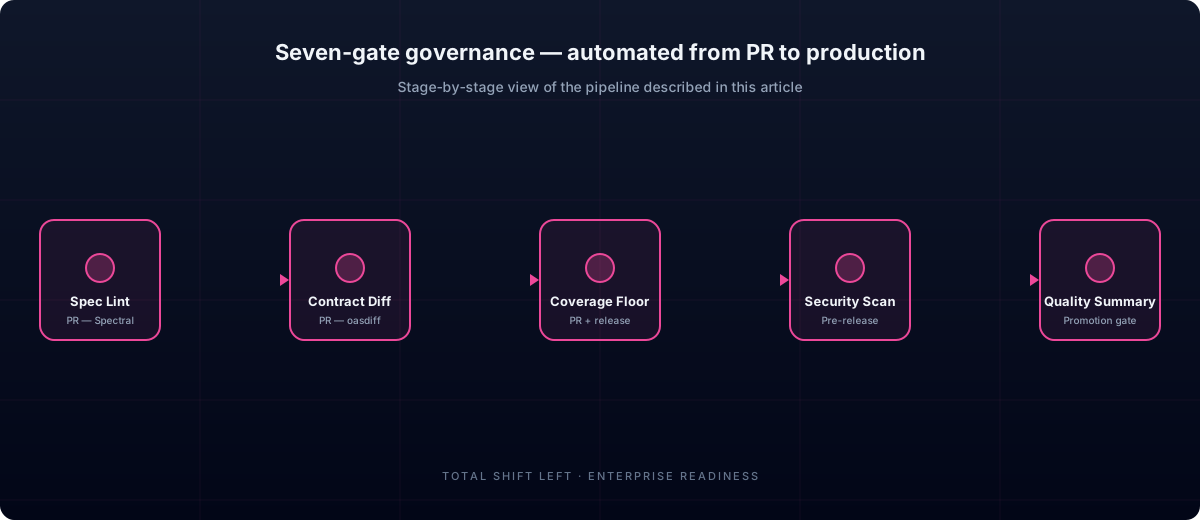
API governance program — seven automated gates from PR to production.
Why this matters at enterprise scale
Postman's 2024 State of the API Report tracked governance maturity across 40,000 organizations and found that automated-gate-driven programs caught 4x more breaking changes pre-production than human-review programs while consuming 60% less engineering time. Governance ROI is a function of automation depth, not policy detail — yet most enterprise programs over-invest in policy and under-invest in enforcement.
Tools landscape
A practical view of the tool categories that scale across enterprise testing programs in this area:
| Category | Example tools |
|---|---|
| Spec linting | Spectral (open source), Redocly Lint, Stoplight Studio governance |
| Contract diff | oasdiff, Optic, Postman Spec Hub |
| Coverage measurement | Total Shift Left coverage dashboards |
| Security scanning | OWASP ZAP, 42Crunch, StackHawk |
| Audit interface | Custom services over centralized aggregation; Backstage plugins for visibility |
Tool selection is secondary to architecture. The patterns above hold regardless of which specific vendor you adopt.
Real implementation example
A representative deployment pattern from an enterprise rollout in this area:
Problem. A fintech with 200+ APIs had governance documents but no automated enforcement. Breaking changes shipped to production monthly. Audit cycles surfaced design-standard violations across the entire API estate.
Solution. The platform team operationalized seven automated gates: spec linting, contract diff, coverage floor, security scan, auth/authz tests, performance baseline, quality summary. Audit interface read from the aggregation. Human review was reserved for the 5% of changes needing judgment.
Results. Breaking changes dropped to ~1 per quarter (and were always intentional). Coverage floor compliance reached 92% within 12 months. Audit findings on API governance dropped from 23 to 0 in the next cycle. Platform team headcount unchanged.
Free 1-page checklist
API Testing Checklist for CI/CD Pipelines
A printable 25-point checklist covering authentication, error scenarios, contract validation, performance thresholds, and more.
Download Free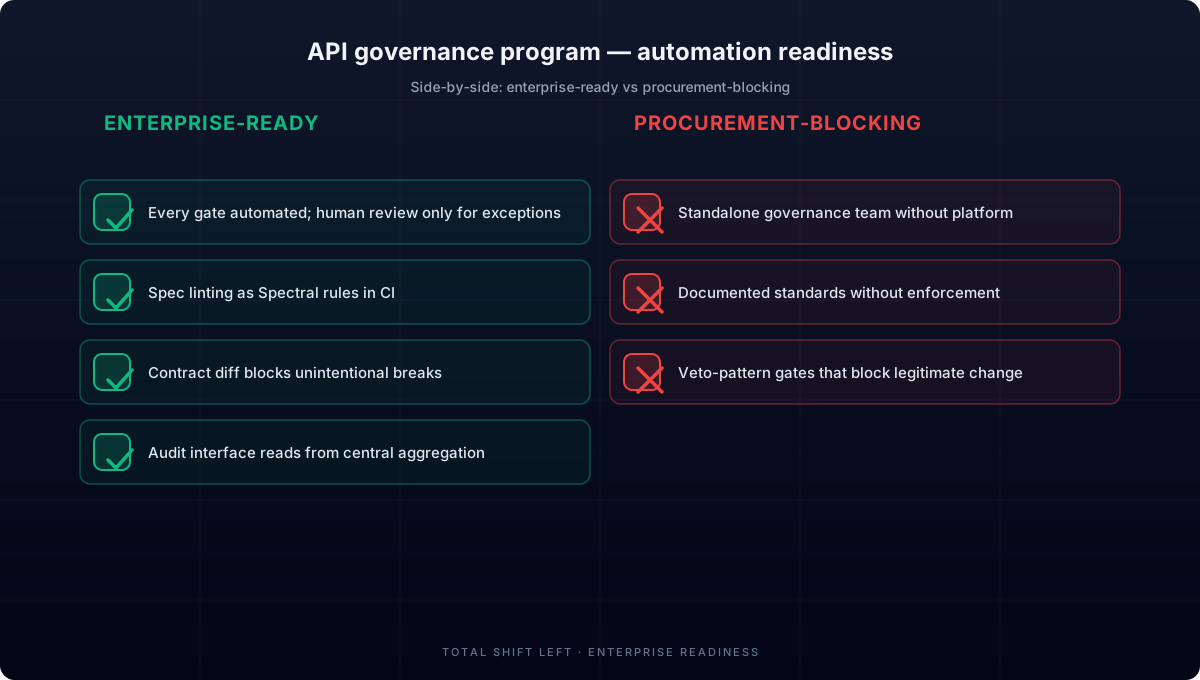
Enterprise API governance — readiness checklist.
Reference architecture
A seven-gate governance architecture has three layers. Per-API CI integration — every API repository's CI runs the seven gates: spec linting, contract diff, coverage floor, security scan, auth/authz tests, performance baseline, quality summary. Centralized policy — design rules in Spectral, breaking-change rules in oasdiff, security baseline in OWASP API Top 10 test corpus, coverage thresholds in CI quality gates. Updated centrally; pulled by every API's CI on each run. Audit interface — thin service over the centralized aggregation that received gate decisions from every CI run. Queryable by API, by date, by gate. Used by engineering leadership for visibility, by compliance for audit response, by security for incident review. The architecture deliberately minimizes per-API operational cost — the gates run automatically on every change without per-API tuning.
Metrics that matter
Three metrics establish governance program health. Breaking-change escape rate — count of unintentional breaking changes reaching production per quarter — is the headline metric; well-run programs trend toward zero. Coverage-floor compliance — percentage of in-scope APIs meeting the coverage minimum — is the operational metric; 90%+ is the floor. Audit-finding closure time — days from finding to documented remediation — measures responsiveness. Report all three on a quarterly cadence to engineering, security, and compliance leadership.
Rollout playbook
Seven-gate governance rollout takes 12-18 months at enterprise scale. Months 1-2: foundation. Build the centralized aggregation. Author initial Spectral and oasdiff rule sets. Define coverage thresholds. Months 3-4: pilot. Onboard 2-3 willing API teams onto the seven gates. Tune false-positive rates on each gate. Validate the audit interface returns correct queries. Months 5-9: rollout. Onboard remaining APIs in priority order — customer-facing, payment, PII-handling first. Phase strict gate enforcement gradually; warning-only for the first two release cycles. Months 10-18: maturity. Strict enforcement on all in-scope APIs. Quarterly review cadence with engineering leadership. Tune policies based on observed program performance. Most enterprises reach 60% gate adoption by month 9 and 90%+ by month 18.
Common challenges and how to address them
Engineers see governance as a tax. Make automated gates fast: sub-30-second feedback for spec linting, sub-5-minute feedback for contract diff. Speed converts gates from tax to safety net.
Standalone governance team has no platform. Move governance ownership to the platform team that operates the gates. Pure-policy teams produce documents; gate-owning teams produce outcomes.
Documented standards aren't enforced. Encode every standard as a Spectral rule or equivalent. If it can't be encoded, it can't be enforced consistently.
Veto patterns block legitimate change. Enable fast change. Reserve gates for the 5% that need judgment; automate the 95%. Engineering will accept gates that are fast and consistent.
Best practices
- Automate every gate that can be encoded; reserve human review for genuine judgment
- Operate gates fast — speed determines whether engineering accepts or routes around them
- Move governance ownership to the platform team that runs the gates
- Encode every design standard as a Spectral rule or equivalent
- Run audit interface as a thin service over the centralized aggregation
- Measure breaking-change escape rate as the primary outcome metric
- Surface gate decisions transparently — engineers should see why their build failed
Implementation checklist
A pre-flight checklist enterprise teams can run against their current state:
- ✔ Spec linting runs in CI on every API spec change
- ✔ Contract diff runs in CI with breaking-change detection
- ✔ Coverage floor is enforced as a CI quality gate
- ✔ Security baseline (OWASP API Top 10) tests run pre-release
- ✔ Audit interface reads from the centralized aggregation
- ✔ Breaking changes require explicit approval with retained rationale
- ✔ Platform team owns both governance policy and gate enforcement
- ✔ Outcome metrics (escape rate, coverage floor compliance) are tracked
Take the next step. See how enterprise governance for API testing applies these ideas to your workflow, or explore security and compliance for the broader picture.
Conclusion
Enterprise API governance is a platform engineering product. The programs that work ship automated gates, central evidence, and an audit interface that scales. The programs that don't ship documentation and human-review processes that decay within months. The seven-gate model is a defensible starting point that most enterprises can extend incrementally.
FAQ
What's the difference between API governance and API testing?
Testing validates one API against its specification. Governance defines what specifications are acceptable, what quality bars every API has to meet, and what evidence demonstrates compliance. Governance is the policy layer; testing is the enforcement mechanism.
Where should an API governance program live organizationally?
Usually with the platform engineering or API platform team, with policy input from security and compliance. A standalone API governance team is rarely sustainable; it needs to be close to the platform that enforces the policies.
How do you stop governance from becoming a bottleneck?
Automate every gate. A governance program that requires human review on every API change becomes the slowest part of delivery. A program that encodes its policies as automated checks (linting, contract tests, security scans) gates only the exceptions.
What's the smallest viable API governance program?
Three things: an API design linter run in CI, a contract test that catches breaking changes between releases, and a quality gate that blocks promotion to production if either fails. Everything else can be added incrementally.
Ready to shift left with your API testing?
Try our no-code API test automation platform free.